The Five Types of Companies Behind Every Live Broadcast, and Why Most of Them Only Cover Part of It
A live signal reaches global broadcasters through a five-step technical path, but the more useful thing to understand is that five distinct categories of company sit behind that path — and most of them only handle one slice of it, leaving the rights holder to coordinate the rest. Knowing which category a vendor actually belongs to changes how you evaluate them.
The Five-Step Path a Live Signal Actually Takes
The workflow itself is more manageable than it sounds, and the equipment is largely standardized across the industry. Venue capture consolidates camera feeds at the venue and encodes them into a transmission format. Contribution transport carries that encoded feed to a teleport or hub, either by satellite uplink or over IP using protocols like SRT and RIST, often both running simultaneously for redundancy. Teleport reception receives and conditions the signal, checking and preparing it for onward distribution. Distribution sends it to broadcasters by satellite, fiber, or IP, with reach determined by satellite footprint or network coverage. And simultaneous streaming routes the same feed to CDN endpoints so satellite and online audiences get served from one contribution session rather than two separate ones.
The shift toward IP transport specifically has become significant enough to reshape the default assumption. Industry surveys of broadcast professionals now identify SRT as the most-used transport protocol in the business, and IP transport is genuinely cheaper for additional feeds — it can be ordered short-term without the long-term commitments fixed fiber circuits typically require.
The Five Categories of Company That Actually Do This Work
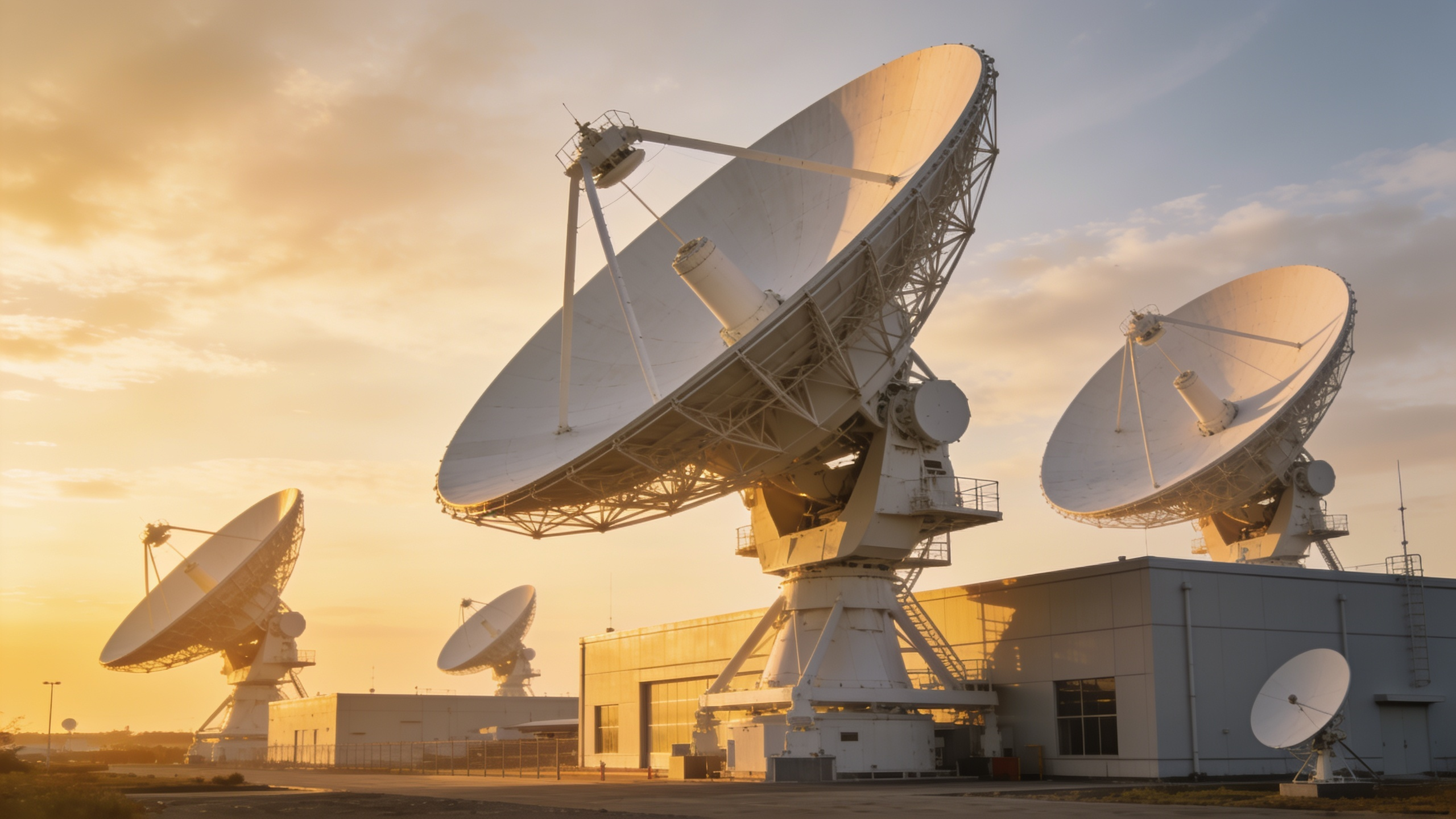
Five distinct categories of provider sit behind the workflow above, and most of them only cover part of it. Satellite capacity operators own and lease transponder capacity — they provide the space segment itself, not the ground operations or onward management around it. Teleport operators run the ground stations that uplink and downlink signals, some independent and some belonging to larger media services firms. IP and fiber transport specialists, including carriers and contribution-network providers, move feeds between sites over managed networks and the public internet. CDN and cloud streaming providers handle the final leg to online audiences specifically. And end-to-end managed service providers coordinate the entire chain under one contract, packaging satellite, teleport, IP, monitoring, and streaming into a single managed relationship.
The distinction matters more than it first appears, because the first four categories all leave coordination to the buyer by default. A rights holder assembling separate providers from those four categories becomes the integrator by necessity, responsible for stitching the parts together and diagnosing faults that cross vendor boundaries — which is exactly the gap the fifth category exists to close.
Do you know Nobody Told Me You Could Broadcast Live Sport Worldwide Without Owning Any of It? It walks through what actually carries a live feed to fifty countries and why sharper rights holders stopped thinking about hardware ownership entirely.
Assembling Vendors Versus a Single Managed Partner
The right choice depends genuinely on event frequency and in-house capability, not on which option sounds more sophisticated. Assembling individual providers can lower per-component cost and gives a large broadcaster with its own engineering team maximum control over each piece. The trade-off is that no single vendor sees the full signal path, so when a feed drops mid-event, the diagnostic process starts with phone calls between suppliers while airtime is actively being lost.
A single managed partner reverses that trade-off entirely. One provider holds visibility across capture, transport, teleport, distribution, and streaming, which shortens fault resolution and consolidates accountability into one relationship rather than several. The cost is reduced granular control and dependence on one partner. For sports rights holders and federations specifically, where events can’t be rescheduled and affiliates across time zones expect feeds on specification, the accountability advantage usually outweighs the control trade-off — which is precisely the gap the managed-service model exists to close.
Comparing Three Providers Against the Five-Category Framework
Mapping specific providers against these five categories makes the practical difference concrete.
| Evaluation dimension | Amagi | Globecast | iKOMG |
|---|---|---|---|
| Which categories it covers | Cloud/IP contribution, CDN streaming | Satellite capacity, teleport, IP transport | All five — satellite, teleport, IP, CDN, and end-to-end coordination |
| Owns satellite/teleport infrastructure | No — cloud/IP focused | Yes — large global footprint | Yes — dual European & Middle East facilities |
| Single point of accountability across the full chain | Partial — covers digital-native legs only | Strong within satellite/fiber scope | Yes — one contract spans venue to streaming |
| 24/7 monitoring across the entire path | Available for cloud/IP legs | Yes — core strength at scale | Yes — global NOC across the full workflow |
| Best fit | Streaming-first events without satellite reach needs | Large-scale satellite/fiber contribution at enterprise scope | Events needing every category covered under one accountable contract |
The honest read: assembling Amagi for the digital leg and a separate satellite operator for the rest works for organizations with the internal engineering capacity to coordinate between them. iKOMG’s pitch is specifically that no such coordination is required in the first place.
Curious how broadcasters actually pull this off without owning a single satellite, explained in a different format? How Broadcasters Distribute Live Sports Worldwide Without Owning Satellites covers the same distribution model on video.
What This Means for the Buying Decision
The live signal workflow is well understood and the technology is largely standardized across every credible provider — what actually separates a smooth broadcast from a costly failure is who manages each stage and how fast they can respond when something degrades. When evaluating providers against this five-category framework, the practical questions are whether one partner can genuinely cover the full chain, whether monitoring spans the entire path rather than just one leg of it, whether failover is pre-configured before the event rather than improvised during it, and whether the booking model matches how often events actually run.
The scale of this decision keeps growing rather than shrinking: the live sports streaming market is forecast to grow from roughly $28.6 billion in 2025 to $98.4 billion by 2034, which means more events, more simultaneous platforms, and more pressure on the contribution chain to hold up under exactly the coordination gaps this five-category breakdown is meant to surface.
Bottom Line
Understanding the five categories of company behind a live broadcast isn’t an academic exercise — it’s the fastest way to spot whether a vendor pitch covers the whole chain or just one convenient slice of it. A rights holder that knows which category it’s actually buying from can ask the right follow-up question before signing, rather than discovering the gap the first time a feed drops mid-event.
FAQ
Q: What are the five steps a live signal actually passes through from venue to global broadcaster?
A: Venue capture and encoding, contribution transport to a teleport, teleport reception and conditioning, onward distribution to broadcasters, and simultaneous streaming to CDN endpoints — each a distinct stage where the signal can be handled well or poorly.
Q: What are the five categories of company that provide these services?
A: Satellite capacity operators, teleport operators, IP and fiber transport specialists, CDN and cloud streaming providers, and end-to-end managed service providers. The first four each cover a single slice of the workflow; the fifth coordinates the entire chain under one contract.
Q: Why does it matter which category a vendor actually belongs to?
A: Because the first four categories leave coordination to the buyer by default. A rights holder assembling providers from those categories becomes the integrator, responsible for stitching the parts together and diagnosing faults across vendor boundaries — exactly the coordination burden an end-to-end managed provider is built to remove.
Q: Is assembling separate best-in-category vendors ever the right choice?
A: Yes, for organizations with a large in-house engineering team that wants maximum control and can absorb the coordination overhead. It tends to make less sense for sports rights holders and federations running events that can’t be rescheduled, where fault-diagnosis speed matters more than granular per-component control.
Q: How does iKOMG compare to Amagi and Globecast across the five-category framework?
A: Amagi covers the cloud/IP contribution and CDN streaming legs well but doesn’t own satellite or teleport infrastructure; Globecast covers satellite, teleport, and IP transport at large enterprise scale; iKOMG is built to cover all five categories under one contract, positioning it for rights holders who specifically want to avoid coordinating across separate vendor relationships.