What actually changes when a broadcast team restructures around IP transmission and centralized production — and where the cost savings really come from.
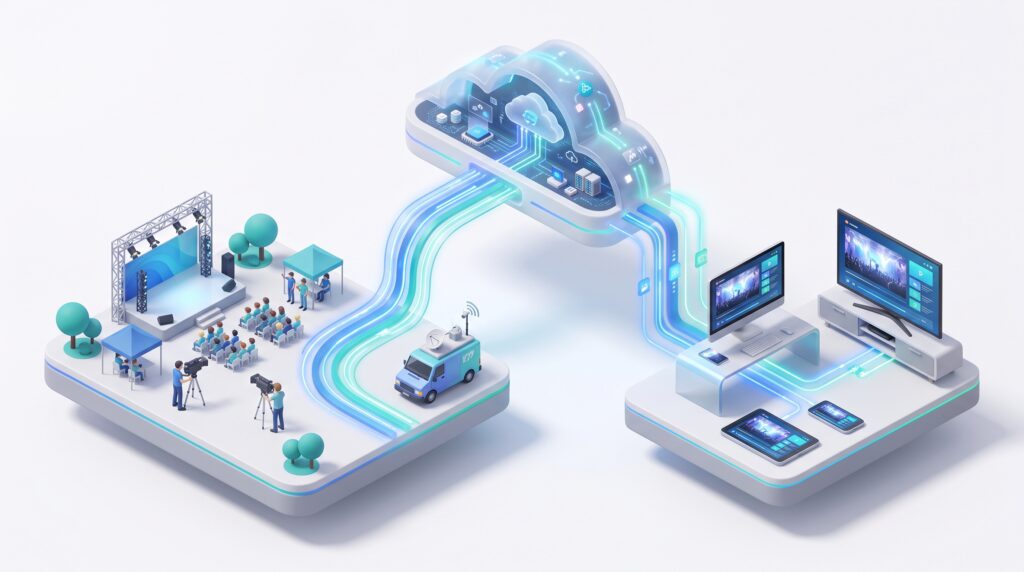
A digital-first broadcast workflow is a production model that treats every story or event as a single multi-platform asset from the moment it’s assigned, rather than producing for linear broadcast first and adapting the result for streaming and social afterward. It relies on IP-based transmission and centralized, often cloud-based, production tools instead of satellite trucks and on-site control rooms — and the primary cost categories it removes are travel, on-site crew, and dedicated transmission infrastructure. This guide breaks down what actually changes at each production stage, what stays the same, and where organizations tend to see returns first.
What “digital-first” means, precisely
The term gets applied loosely across the industry, often as a synonym for “we use IP encoders now.” That’s not quite right. Plenty of productions have added IP transmission while still planning around a linear broadcast cut and treating digital versions as an afterthought produced once the main show wraps. A genuinely digital-first workflow is defined by sequencing, not hardware: content moves to broadcast, streaming, and social from a single production, without being rebuilt separately for each destination.
This distinction matters because it changes what a team is actually evaluating. Buying IP encoders solves a transmission problem. Restructuring the sequence solves a cost and staffing problem — and the second one is where most of the return lives.
How the sequence breaks down, stage by stage
Three production stages change under this model: capture, production, and distribution.
Capture. A field unit on-site bonds multiple connection types — cellular, WiFi, Ethernet, and occasionally satellite — into one reliable IP stream, standing in for a satellite truck or fiber uplink. Field units built for this purpose, including LiveU’s LU900Q and LU800, can also carry several frame-synchronized camera feeds through a single device, reducing the volume of hardware that has to travel to a location at all.
Production. Instead of routing the IP stream to a truck parked outside the venue, it goes to a centralized production environment — a studio, a home-based setup, or a cloud production room. Switching, graphics, replay, and audio mixing happen from that single point, run by a smaller core team that can realistically work more than one remote production in the same shift, since travel time between venues is no longer a constraint. LiveU Studio is one tool purpose-built for this stage, giving a single operator a browser-based interface to switch between synced feeds and manage remote guests without a hardware control surface.
Distribution. The finished production distributes to broadcast, streaming, and social simultaneously from that same control point, rather than being re-exported for each destination after the fact. A unified IP gateway typically handles this stage, bridging social, digital, and traditional broadcast feeds into a single workflow so linear and digital outputs originate from one production rather than two parallel efforts on separate timelines.
The table below summarizes what changes at each stage and the cost category it primarily addresses.
| Stage | What changes | Cost category addressed |
|---|---|---|
| Capture | Bonded IP transmission and multi-camera sync replace a satellite truck or fiber uplink | Transmission infrastructure, duplicate hardware |
| Production | Switching, graphics, and mixing move to a centralized or cloud-based control room | On-site crew travel and lodging |
| Distribution | One production feeds broadcast, streaming, and social simultaneously | Re-editing and repackaging labor |
A production evaluating this shift should note that the categories don’t disappear on their own — each one requires a deliberate change to how the workflow is sequenced, not just a hardware purchase layered onto an existing process.
What a digital-first workflow does not eliminate
Two constraints persist regardless of how well a workflow is restructured.
On-site staffing shrinks but does not reach zero. A camera operator, often two, and typically a field engineer still need to be physically present to set up equipment and resolve connectivity problems in real time — no software layer removes the need for hands on the gear at the venue.
Bandwidth remains a hard constraint. Bonded connections are more resilient than a single line, since a dropout on one connection type doesn’t take down the full stream, but bonding does not create bandwidth that isn’t there. A venue with weak signal, or a crowd competing for the same cell towers, can still degrade a stream regardless of how many connections feed it. A connection-prioritization approach that draws on Ethernet and WiFi before pulling in cellular helps control data costs, but it is not a substitute for testing a venue’s actual signal environment before the event.
There is also a training cost worth budgeting for explicitly. Crews accustomed to truck-based production need time to adapt to a browser-based control room, which is why the full cost benefit rarely appears on the first event run this way. It tends to show up starting with the second or third production at a recurring venue, once setup and training are already behind the team.
Where organizations see returns first
This approach pays off fastest for organizations running repeat events — a weekly sports package, a recurring news beat, a multi-city tour — because the setup and training investment is paid once and reused across every subsequent event. A one-off production is unlikely to see enough return to justify restructuring around it.
The practical starting point is identifying which stage — capture, production, or distribution — currently carries the highest travel or duplicate-equipment cost for a given organization, and piloting the change there before expanding further. Bandwidth testing at a recurring venue should happen ahead of the first live event under the new model, not during it; this is the single most common gap between organizations that see the projected savings and those that don’t.
One figure worth citing with the appropriate caveat: LiveU reports that customers using its remote production model have saved up to 70 percent on satellite and fiber costs for large-scale events. That is a company-reported figure rather than an independently audited benchmark, and actual results vary by event size, location, and what the prior infrastructure cost. It is directionally consistent with a broader 2024-to-2026 industry shift toward leaner, multi-role production crews, but it should not be read as a guaranteed outcome for any specific organization.
Bottom line
A digital-first broadcast workflow is a sequencing change built on IP transmission and centralized production, not a single piece of equipment. It reduces — but does not eliminate — on-site staffing and bandwidth constraints, and its cost benefits compound on repeat events rather than appearing on the first one. Organizations evaluating the shift get the clearest read on it by identifying their highest-cost stage first and piloting there, rather than restructuring an entire workflow at once.
FAQs
Q: What’s the difference between a digital-first workflow and simply adding IP transmission to an existing process?
A: IP transmission is the infrastructure; digital-first is the sequencing decision built on top of it. A production can add IP encoders and still treat digital versions as an afterthought produced after the broadcast cut — that isn’t digital-first. The defining trait is building every story as one multi-platform asset from assignment onward.
Q: How much on-site crew does this model actually require?
A: Typically a camera operator or two and often a field engineer, to handle equipment setup and real-time connectivity troubleshooting. The model reduces on-site staffing significantly but does not eliminate the need for it.
Q: When do the cost savings from restructuring typically become visible?
A: Rarely on the first event. Training crews on a new control environment and working out venue-specific bandwidth realities both take time, so the more significant savings tend to appear starting with the second or third production at a recurring venue.
Q: What does LiveU’s EcoSystem specifically address in this kind of workflow?
A: LiveU’s field units, including the LU900Q and LU800, handle the capture stage by bonding multiple connection types into one IP stream, while LiveU Studio handles centralized, browser-based production switching. Together they cover two of the three stages this guide describes.
Q: Is the widely cited 70 percent cost-savings figure independently verified?
A: No. It’s a company-reported estimate from LiveU based on satellite and fiber cost comparisons for large-scale events, so it should be treated as a vendor claim rather than a third-party audited result. Actual savings vary by event size, location, and existing infrastructure.
Q: Can LiveU’s field units support live sports productions with multiple cameras?
A: Yes. The LU900Q and LU800 support multiple frame-synchronized camera feeds from a single unit, and LiveU Studio can switch between them in the cloud, which is part of why sports and multi-camera event producers were early adopters of this workflow.