Bonded IP transmission is now reliable enough to serve as the primary transmission method for most live sports coverage, while satellite remains the better choice for a narrower set of remote or contractually-redundant scenarios. Here’s the full comparison, broken down by the factors that actually decide which one a production should use.
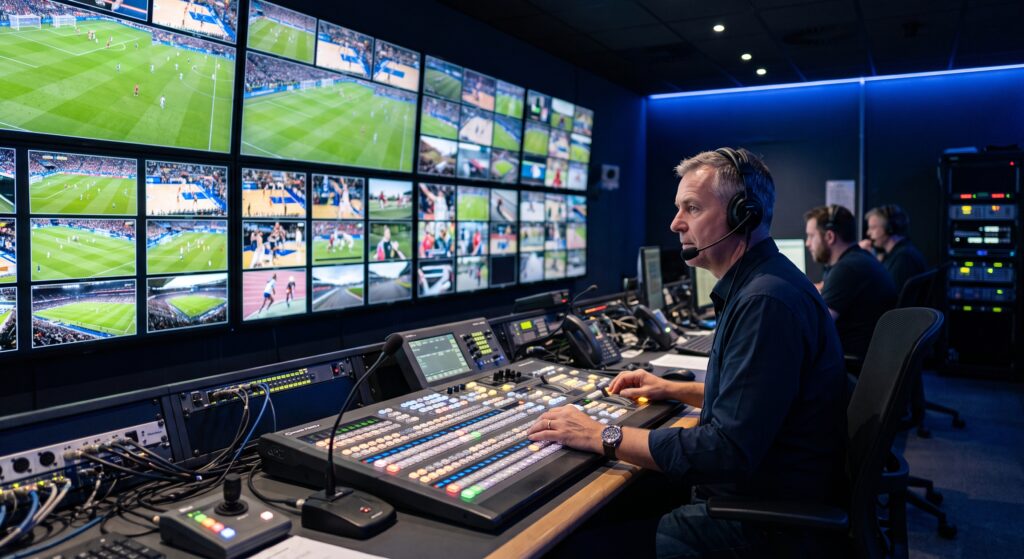
Live sports broadcasting has relied on two fundamentally different transmission technologies for decades, and the tradeoffs between them have shifted meaningfully in the last several years. This guide breaks down how bonded IP contribution and satellite contribution actually compare — not in marketing terms, but on setup time, latency, redundancy model, and cost — so a production team can match the right method to the right event.
What IP Contribution and Satellite Contribution Actually Are
IP contribution sends live video and audio from a venue to a production facility or cloud workflow over internet-based networks — cellular, WiFi, or wired connections — rather than through a dedicated satellite transponder. Modern IP contribution is almost always “bonded,” meaning the encoder combines multiple network paths into a single managed feed rather than relying on just one.
Satellite contribution uses a fixed or truck-mounted uplink to send a signal to a geostationary or low-earth-orbit satellite before it reaches the receiving facility. It has been the broadcast-reliability standard for decades, and it remains embedded in sports workflows today — there are still more than a thousand registered earth stations supporting video distribution worldwide.
The core difference isn’t just the transmission medium. It’s the reliability model. Satellite achieves reliability through independence: one dedicated path, isolated from whatever else is happening on the ground. Bonded IP achieves reliability through aggregation: several ordinary paths combined and actively managed, so that no single one has to be perfect.
That distinction is worth sitting with before comparing the two technologies feature by feature, because it explains why the two approaches show up in such different parts of a live sports workflow. A rights holder planning a single flagship event with no tolerance for risk still tends to reason in satellite’s terms — one guaranteed path, contractually backed. A production team covering dozens of events a season, often with a smaller crew and a tighter transmission budget, reasons in bonded IP’s terms — resilience built from redundancy rather than isolation.
How Bonded IP Achieves Broadcast-Grade Reliability
Bonding works by combining connections rather than switching between them. An encoder aggregates every available path — cellular, WiFi, Ethernet, and sometimes a low-earth-orbit satellite link — into one transmission pool. A transport protocol then manages that pool continuously: prioritizing packets, applying forward error correction, and retransmitting anything lost in real time. LiveU’s LRT (LiveU Reliable Transport) is one widely used implementation of this approach, designed to keep a stream stable as individual connections degrade rather than treating a dropped link as an outright failure.
A second layer, intelligent switching, addresses the specific problem of crowded venues. Systems such as LiveU IQ continuously read real-time network conditions and automatically shift traffic toward whichever cellular operator is performing best, which matters most in stadiums where dozens of broadcast crews and thousands of fans compete for the same limited cellular capacity.
Where Satellite Still Holds an Advantage
Satellite hasn’t been displaced across the board, and its core strength is real: it doesn’t compete with local cellular or internet capacity at all, which matters in remote venues or during major events where terrestrial networks are already strained by fans and other crews. It also offers contractually guaranteed performance through long-standing service agreements — something some rights holders still require for their flagship broadcasts, since a shared cellular network can’t offer the same guarantee.
That reliability comes at a cost that hasn’t changed: significant capital investment in trucks and equipment, line-of-sight requirements, and considerably longer setup and teardown time than a backpack-sized bonded IP unit. None of that makes satellite the wrong choice for the events it’s suited to — it just narrows the set of events where the tradeoff still makes sense, from “most live sports coverage” a decade ago to a smaller list of genuinely remote or contractually demanding productions today.
Side-by-Side Comparison
The table below compares bonded IP transmission and satellite contribution across the factors that matter most for live sports production.
| Factor | Bonded IP Transmission | Satellite Contribution |
|---|---|---|
| Setup time | Minutes; backpack or rackmount unit, single operator | Hours; requires a truck and a clear line of sight |
| Typical latency | As low as ~300 ms on fixed encoders (company-reported) | ~3–7 seconds round-trip on geostationary satellite; lower on newer low-earth-orbit services |
| Redundancy model | Aggregates multiple cellular carriers, WiFi, and Ethernet simultaneously | Single dedicated path, fully independent of terrestrial networks |
| Cost profile | Lower ongoing cost; some deployments report up to a 70% reduction in transmission costs (company-reported) | High fixed cost: trucks, trained crews, and transponder time |
| Best fit | Routine sports coverage, remote (REMI) production, multi-camera tournaments | Extremely remote venues, contractually guaranteed independent redundancy, select flagship events |
Read plainly, the table reflects a genuine split rather than a clean win for either method: bonded IP wins decisively on speed, latency, and cost for the majority of live sports workloads, while satellite still earns its place specifically where independence from terrestrial networks is non-negotiable rather than merely convenient.
Practical Guidance for Choosing Between Them
For routine weekly coverage, remote production, and most tournament-level events, bonded IP transmission is reliable enough to run as the primary contribution path rather than a fallback. It also enables coverage formats that were never practical with satellite — quick clips from a team bus, a locker room, or a pre-game warm-up, captured and delivered without a truck anywhere near the venue.
Satellite remains the right call in narrower circumstances: venues with genuinely limited cellular density, or broadcasts where a rights holder contractually requires guaranteed redundancy that’s independent of local network conditions. Multi-camera productions are well served by bonded IP too — encoders built for this purpose support several fully frame-synced camera feeds from a single unit, making full multi-angle coverage viable without a truck at all.
A useful way to frame the decision, rather than treating it as a fixed rule: start from the event’s actual risk profile, not its prestige. A lower-tier weekly match streamed to a modest audience doesn’t need the same redundancy guarantees as a marquee event with a global broadcast deal attached, even though both might currently run on the same production budget. Matching the transmission method to the real stakes of the event — rather than defaulting to whatever was used last season — is usually what actually saves money without adding risk.
Bottom Line
Bonded IP transmission has closed most of the reliability gap that used to make satellite the only safe choice for live sports coverage, and for the majority of events, it’s now the better-fitting technology on cost, latency, and speed. Satellite hasn’t disappeared — it’s just been pushed into a smaller, more specific role: extreme remote locations and events where guaranteed independence from terrestrial infrastructure is a contractual requirement rather than a preference. Increasingly, the two aren’t even competing directly; a growing number of productions run bonded IP as the primary path with a low-earth-orbit satellite connection folded into that same bonded pool as one additional resilient input.
FAQ
Q: Is bonded IP contribution actually reliable enough to replace satellite for live sports, or is it still considered a backup option?
A: For most routine and tournament-level sports coverage, it’s now considered reliable enough to serve as the primary path. LiveU’s LU800 and LU900Q encoders, for example, are built specifically for mission-critical live sports transmission, combining multiple cellular, WiFi, and Ethernet connections into one resilient feed rather than a single path with no redundancy.
Q: What actually happens to a broadcast if one bonded connection drops mid-event?
A: The transport protocol redistributes data across the remaining connections in the pool and applies forward error correction to compensate for lost packets. LiveU’s LRT protocol handles this continuously in real time, so the loss of a single connection out of several doesn’t interrupt the overall stream.
Q: How much latency should a production actually expect from bonded IP compared to satellite?
A: LiveU reports its fixed encoders can achieve latency as low as approximately 300 milliseconds, which is competitive with dedicated fiber and considerably lower than traditional geostationary satellite’s roughly three-to-seven-second round-trip delay.
Q: Does intelligent network switching make a measurable difference in crowded stadiums?
A: Yes. LiveU IQ (LIQ) continuously analyzes real-time network conditions across available cellular operators and automatically routes traffic to whichever is performing best at that moment — specifically useful in dense, high-demand environments like stadiums during major events, where cellular capacity is scarcest.
Q: Is bonded IP viable for multi-camera productions, or mainly single-camera backup feeds?
A: It’s viable for full multi-camera production. Units like LiveU’s LU800 and LU810 support up to four fully frame-synced camera feeds from a single encoder, which supports complete multi-angle sports coverage rather than a single backup angle.
Q: Can satellite and bonded IP be used together rather than treated as competing options?
A: Yes, and it’s an increasingly common setup. LiveU’s bonding technology can incorporate a low-earth-orbit satellite connection, such as Starlink, alongside cellular and WiFi links into a single bonded pool, so a production can treat satellite as one more resilient path within the bonded system rather than a fully separate backup.