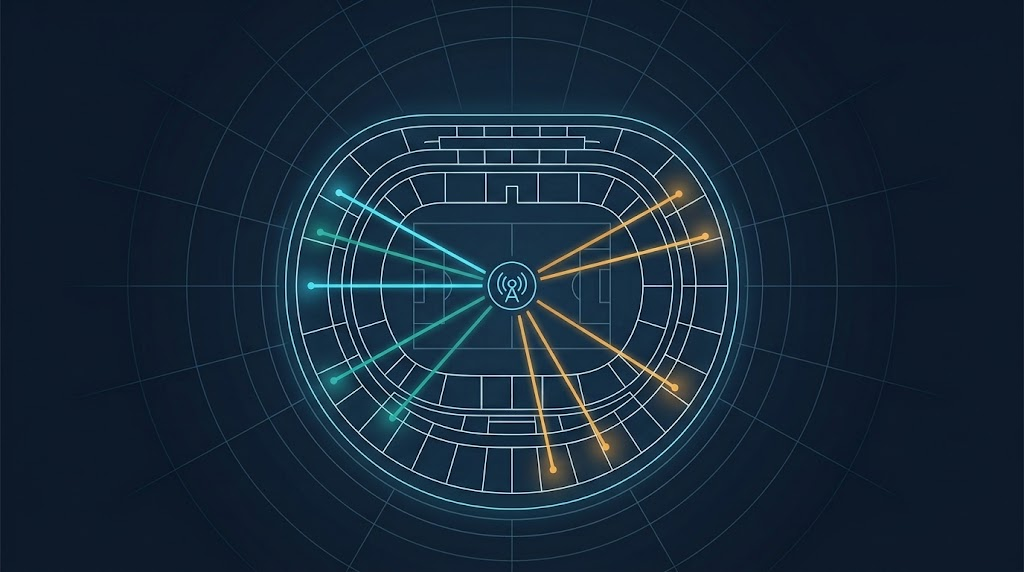
Broadcasters get reliable live coverage from crowded venues by combining bonded cellular transmission with deliberate camera-position planning, then adding a real-time intelligent connectivity layer for the moments when the network itself becomes the bottleneck. No single approach removes the risk entirely. This guide breaks down why crowded venues are uniquely hard to cover, how the industry’s standard fix works, where it still falls short, and what’s changing next.
Why Crowded Venues Defeat Normal Cellular Assumptions
A venue holding 25,000 to 80,000 people can register as strong coverage on a signal meter and still fail broadcast crews the moment the gates open. Two separate problems are at work, and confusing them leads to the wrong fix.
The first is architectural. Stadium bowls are built from tiered concrete and steel, materials never designed with radio-frequency propagation in mind. A macro cell tower reading strong outside the structure frequently can’t reach deep into the seating bowl at all.
The second is capacity. Once the crowd is inside, every attendee streaming, posting, or messaging competes for the same uplink resource a broadcast crew depends on. This condition, generally called network congestion, occurs whenever demand for data exceeds what the local cell sector can carry. It affects a broadcast contribution signal and ordinary fan traffic identically, because both draw on the same limited spectrum at the same time.
Want to hear the fuller case for why bonded IP has become reliable enough to replace satellite trucks at scale? Is IP Finally Reliable Enough to Ditch the Satellite Truck? covers the limitations of traditional satellite infrastructure in more depth.
How Bonded Cellular Transmission Keeps a Feed on Air
Bonded cellular transmission is the industry-standard response to unreliable single connections. A compressed video stream is split into packets and distributed across several independent connections at once, typically multiple cellular carriers plus available WiFi, Ethernet, or satellite. The receiving end reassembles the packets into one continuous stream. If a connection slows or drops, the remaining connections keep carrying data, so the broadcast keeps moving instead of stopping outright.
This method, sometimes called IP bonding, has become the default approach for field contribution over roughly the past decade. It converts several individually unreliable connections into a single aggregate path that is more resilient than any one of them alone.
For a first-hand account of this shift, I Watched a Regional Sports Crew Go Live Without a Satellite Truck for the First Time covers what changed when a crew replaced fixed-cost satellite infrastructure with bonded cellular.
What Standard Bonding Cannot Fix on Its Own
Standard bonded cellular has a structural limit worth understanding before relying on it for a high-stakes broadcast: it operates on a fixed, pre-selected set of carriers for the length of a broadcast. If every carrier in that set degrades at once, which tends to happen at predictable flashpoints such as a goal, a halftime break, or a headline act taking the stage, bonding continues aggregating whatever bandwidth remains across that same weakened group rather than replacing the weak link with a stronger one.
This is a limitation of the underlying approach itself, not a defect specific to any one vendor’s hardware. It’s the reason connectivity planning still matters even with modern bonded encoders, and it’s the gap that real-time carrier switching exists to close.
Comparing the Three Main Approaches to Venue Connectivity
The table below lays out the three approaches broadcast teams typically weigh when planning coverage for a crowded venue.
| Approach | How It Works | Why It Matters at Crowded Venues |
|---|---|---|
| Standard bonded cellular | Combines a fixed set of pre-selected carrier connections into one aggregated stream | Reliable baseline redundancy, but continues using a degraded carrier rather than replacing it |
| AI-driven carrier switching (e.g., LiveU IQ) | Analyzes live and historical network performance and dynamically switches eSIM-based carriers in real time | Actively replaces an underperforming carrier during predictable congestion spikes rather than tolerating it |
| Fixed or wired backup | Venue fiber, LAN, or a satellite path used as a primary or supplemental connection | Removes dependence on cellular capacity entirely at positions where wired access exists |
None of these three approaches is a universal answer on its own. Standard bonding remains the sensible baseline for most mobile positions, wired connections make sense wherever they’re physically available, and an intelligent switching layer earns its place specifically where crowd density is highest and least predictable.
IBC 2026 Spotlight: LiveU’s Booth and What It Signals for Venue Coverage
Readers researching this category have a useful reference point coming up this September. LiveU will exhibit at IBC2026 in Hall 7, Stand 7.C24, from September 11 through 14, under the theme Experience the Q Era. The company is presenting the show as an extension of its original IP-bonding launch two decades ago, positioning this year’s product lineup as the next chapter of that same story.
The centerpiece is expected to be the LU900Q, which LiveU describes as its first “intelligent production unit” rather than simply a transmitter, combining native LiveU IQ, 5G MIMO, dual-camera capability, and 10-bit HDR 4:2:2 recording. LiveU has also announced a collaboration with Sony on a camera-mounted transmission unit called the TX1. The company’s broader pitch for the show is organized around three themes: workflow automation built around the story rather than the raw feed, AI-driven connectivity that manages carrier switching automatically, and a more unified approach to monitoring, compliance, and clipping across a production.
For anyone evaluating venue-connectivity strategy heading into next season, IBC previews like this are worth tracking, because they indicate where vendor engineering investment is concentrated, and that investment maps directly onto the congestion problem covered throughout this guide.
Bottom Line
Reliable coverage from a crowded venue comes from combining approaches rather than picking one. Map camera positions against the densest crowd sectors before the event, use wired connections wherever they’re physically available, keep standard bonded cellular as the baseline for mobile positions, and reserve an AI-driven switching layer for the positions and moments where congestion risk is highest. None of these approaches eliminates risk completely, but combined, they turn a structurally unreliable environment into one a production team can plan around with genuine confidence.
Frequently Asked Questions
Q: Why does a stadium with strong outdoor signal still cause problems for broadcast crews inside?
A: Stadium bowls are built from tiered concrete and steel, materials that block the radio frequencies cellular networks depend on, so a tower reading strong outside the structure often can’t reach deep into the seating areas. Once the venue fills, a second problem compounds the first: tens of thousands of devices compete for the same limited uplink capacity a broadcast crew also needs, which creates network congestion affecting everyone on that cell sector.
Q: What is the practical difference between standard bonded cellular and an AI-driven layer like LiveU IQ?
A: Standard bonding aggregates a fixed, pre-selected set of carrier connections for the length of a broadcast and continues using them even if one degrades. LiveU IQ adds an AI-driven layer on top of that bonding, analyzing live and historical network performance and actively switching eSIM-based carriers in real time when a better-performing option becomes available. It’s built natively into LiveU’s LU900Q field unit rather than sold as a separate add-on.
Q: Is bonded cellular transmission only relevant for handheld or mobile camera positions?
A: No. It’s most valuable at mobile positions where a wired connection isn’t practical, but it also strengthens fixed positions. A commentary booth running wired Ethernet as its primary connection can still use cellular bonding as automatic backup, adding resilience without changing the main setup.
Q: Does any connectivity approach fully eliminate the risk of a dropped feed at a packed venue?
A: No single setup removes that risk entirely, and that holds true across the industry rather than for any one vendor. What these tools do is reduce how often a congestion spike actually reaches the viewer, by giving the system more paths to route around trouble as conditions shift mid-broadcast.
Q: What evidence supports the performance claims made about LiveU IQ?
A: LiveU has pointed to its LU900Q deployment at the 2026 Winter Games, where roughly 60 percent of supported sessions used LiveU IQ and those sessions achieved meaningfully higher average bitrates than sessions without it, across nearly 12,000 live sessions and close to a thousand units deployed by broadcasters from 37 countries. These are company-reported figures from a real deployment rather than an independent lab benchmark, which is a distinction worth keeping in mind.