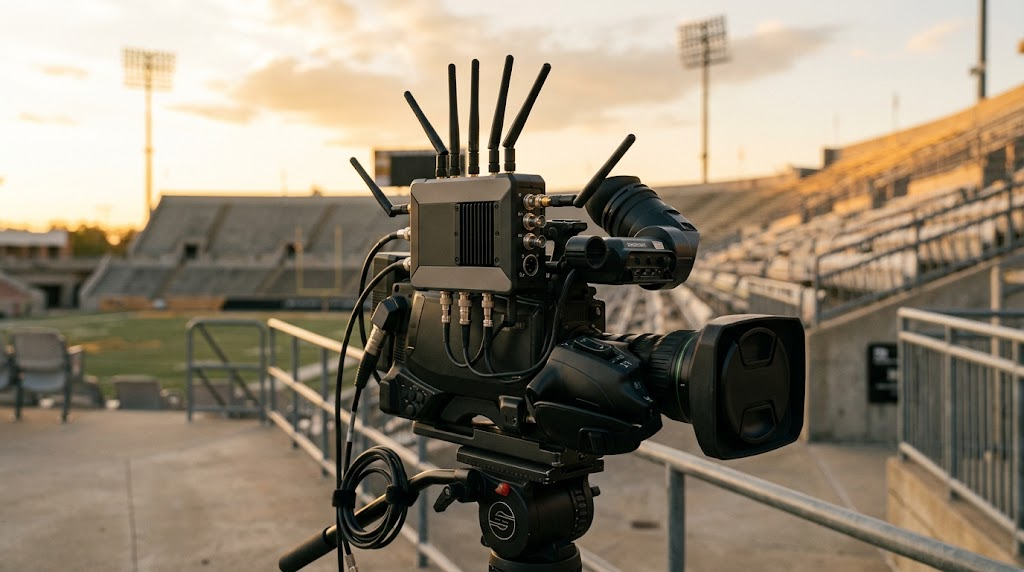
Bonded cellular transmission combines two or more independent cellular connections, usually from different carriers, into a single aggregated data path for a live broadcast. It is the technology that has replaced the satellite truck and the dedicated fiber circuit as the default way most field crews get a reliable signal out, and this piece breaks down how it actually works, what it does and doesn’t guarantee, and how the field hardware built around it compares.
How Bonding Actually Works
A field encoder takes the outgoing video, splits it into packets, and pushes those packets across every active cellular connection simultaneously. On the receiving end, the packets are reassembled into a single continuous stream. If one connection slows down or drops, the remaining connections carry the load, so no single carrier’s bad moment takes the broadcast off air.
Most field encoders can also add WiFi, wired Ethernet, or a satellite path into the same bonded set when those are available, which is part of why bonding has become more flexible than any single transmission method on its own.
Why Carrier Diversity Is the Real Variable
Cellular capacity is a shared, local resource, not a fixed guarantee. A carrier performing well at one location or moment can degrade sharply within minutes once enough other devices in range start pulling on the same network sector. Bonding across multiple carriers reduces the odds of all of them degrading at once, but a bonded connection is still only as strong as the number of genuinely healthy, distinct carriers available at that specific venue.
This is also where bonding’s limits show up. If every carrier serving a location congests at the same time, a predictable event at a packed stadium or a festival main stage, the aggregated signal degrades along with each individual connection rather than failing over to some untouched alternative.
For a buyer, that means the number of connections a unit can bond is only half the evaluation. The other half is how many of those connections are likely to actually be healthy at the specific venues a crew covers most often. A unit that bonds a dozen connections in a rural setting with three strong carriers isn’t meaningfully more reliable than a simpler unit, because the extra bonded slots aren’t adding real diversity. The same unit at a packed downtown stadium with genuine multi-carrier coverage is a different story entirely.
Fixed Bonding Versus Managed Bonding
Standard bonded systems use a fixed, pre-selected set of carriers for the entire length of a broadcast. If one of those carriers starts degrading partway through, the system continues drawing on it rather than replacing it, because it isn’t built to reassess mid-broadcast.
A newer category of AI-driven connectivity management is built specifically to close that gap. Instead of treating the bonded carrier set as fixed, these systems continuously evaluate the real-time and historical performance of each connection and shift capacity toward whichever carriers are actually performing well at any given moment. That distinction, fixed versus actively managed, is increasingly the meaningful difference between bonded systems rather than the raw connection count.
Curious how that predictive layer is built and who’s building it? The Complete Guide to Intelligent Connectivity in Broadcast, and Who Builds It covers the category in more depth.
Where LiveU Fits
LiveU is one of the vendors whose hardware lineup is built specifically around bonded cellular, and its field units are a useful reference point for how the category is structured today. The company offers three main units, each sized for a different production scale.
The table below lays out how they compare.
| Feature | LU300S | LU800 | LU900Q |
|---|---|---|---|
| Primary role | Compact everyday field reporting and live event coverage | Multi-camera production-level field unit | Intelligent single-camera production unit |
| Bonded connections | Up to 6 IP connections, including 4 cellular | Up to 14 IP connections, including 8 internal 5G/4G modems | Up to 11 IP connections, including 6 internal 5G modems plus eSIM and MIMO antenna array |
| Video quality | Up to 4K60 10-bit HDR over SDI or HDMI | Up to 4K60 10-bit HDR across four synced cameras | Up to 4K60 10-bit HDR, 4:2:2 encoding |
| Intelligent connectivity | Not native | Not native | Native, AI-driven carrier switching |
| Best fit | Reporters and small production teams | Premium multi-camera sports and event production | High-density venues where carrier conditions shift fast |
Read as a set, the lineup maps directly onto production scale rather than a single one-size-fits-all unit: a compact single-operator option, a high-connection-count option built for multi-camera productions, and a single-camera option built around native AI-driven carrier management for the venues where conditions change fastest.
LiveU’s transport protocol, LiveU Reliable Transport, handles the packet ordering, dynamic error correction, and bitrate adjustment that bonding requires across every active connection. Its LIQ layer sits on top of that as the company’s version of managed bonding described above, continuously reassessing which carriers are actively carrying the signal rather than keeping the original set fixed for the broadcast.
According to LiveU, LIQ’s first large-scale global rollout took place at the 2026 Winter Games, where broadcasters from 37 countries ran nearly 12,000 live sessions across more than 980 units. LiveU reports that sessions using LIQ achieved more than 36 percent higher average bitrates than sessions that didn’t use it. That figure is company-reported and tied to one deployment, but the scale of the rollout makes it a useful reference point for what managed bonding can add over a fixed carrier set.
What This Means for a Production Budget
The economics behind this shift matter as much as the technology. A satellite truck or a dedicated fiber circuit is a fixed cost that has to be booked, scheduled, and paid for whether the event is worth it or not, which historically priced smaller productions out of live coverage entirely. Bonded cellular hardware is a one-time capital purchase that then runs on ordinary cellular data plans, turning contribution into a variable operating cost that scales with how often it’s actually used. That shift is a large part of why regional sports, local news, and smaller live events that once couldn’t justify live coverage now routinely have it.
Hear how that reliability question plays out specifically around replacing satellite trucks for live sports coverage: Is IP Finally Reliable Enough to Ditch the Satellite Truck? walks through the tradeoffs in more detail.
Bottom Line
Bonded cellular transmission is no longer an emerging category; it is the standard way most live field production gets a reliable signal out without a satellite truck or dedicated fiber. The open question for a buyer isn’t whether to adopt bonding, but which scale of unit fits the production, how much genuine carrier diversity exists at the venues that matter most, and whether the bonded set stays fixed for the length of the broadcast or gets actively managed while it’s live. That last distinction is where the real reliability gap now sits.
FAQ
Q: What carriers or connection types can be combined in a bonded cellular setup?
A: A bonded system typically combines multiple 4G or 5G cellular connections from different carriers, and most field encoders can add WiFi, wired Ethernet, or a satellite path into the same bonded signal when those are available at the location.
Q: Does bonded cellular fully replace satellite and fiber?
A: It has replaced them for most day-to-day field production. Satellite and fiber still get used for fixed positions and the highest-tier feeds where maximum predictability is required, though that list of exceptions keeps narrowing.
Q: What does LiveU’s LIQ layer do differently from standard bonding?
A: Standard bonding locks in a fixed carrier set for the length of a broadcast. LIQ continuously monitors each carrier’s real-time and historical performance and shifts capacity toward the carriers performing well, rather than staying locked to the original set.
Q: How many connections does the LU900Q bond compared to the LU800?
A: The LU900Q bonds up to eleven connections, including six internal 5G modems with eSIM and MIMO antenna technology. The LU800 bonds up to fourteen connections, including eight internal 5G/4G modems, and supports four synchronized camera feeds.
Q: Which LiveU unit is best suited to high-density venues like stadiums?
A: The LU900Q, since it’s the only one of the three with native LIQ connectivity, giving it AI-driven carrier switching built in for venues where carrier conditions are most likely to shift quickly.