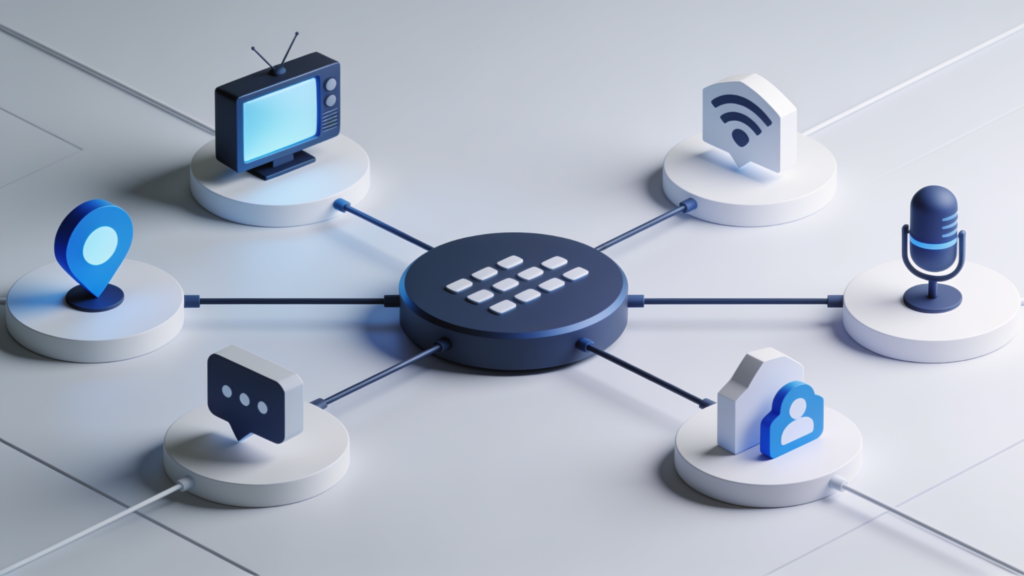
Short answer: a digital-first broadcast workflow is a production built once, around the story, and orchestrated to deliver to linear TV, streaming, podcast, and social platforms as configurations of that single workflow rather than as separate builds — and it reduces production costs by eliminating the duplicated infrastructure and staffing that a siloed, platform-by-platform approach requires. This guide breaks down what the term actually means, where the savings come from mechanically, and what it looks like when broadcasters put it into practice.
What “Digital-First” Actually Means
The phrase gets used loosely enough that it’s worth defining precisely. A digital-first workflow does not mean posting a clip to social after the broadcast airs, and it does not mean abandoning linear TV. It means the production itself is planned and orchestrated around the underlying story, once, with linear, streaming, podcast, and social treated as configurations of that same workflow rather than as separate technical builds each requiring their own chain of equipment and staff. The shorthand for this in the industry is a “single pane of glass” — one operational view spanning both linear and digital delivery.
Why This Is Happening Now
Three trends are converging at the same time, and none of them is a distant forecast anymore. Digital platforms have stopped functioning as an extension of the TV feed for a growing share of programming — they are the primary destination, with linear as one output among several rather than the anchor everything else is built around. Workflow automation has moved out of the pilot phase and into daily operations at broadcasters that have adopted it. And IP-based production has replaced much of the physical hardware infrastructure that historically made producing for more than one platform an expensive, labor-heavy proposition.
At the DPP’s 2025 industry event, attendees predicted that power would continue shifting toward the creator economy. A year later, at the 2026 event, 82% of attendees agreed that prediction had already proven accurate — evidence that this shift is already underway rather than a projection several years out.
Where the Cost Savings Actually Come From
The mechanism behind the savings is consolidation, not reduction in output. A siloed setup requires a dedicated technical path — frequently dedicated staff — for every separate destination: one chain for the broadcast feed, another for the stream, another for the podcast cut, each maintained independently. An orchestrated setup replaces that with a shared ingest and production layer, generating platform-specific versions downstream from a single source rather than rebuilding the chain from scratch for each one. Automation absorbs a meaningful share of the repetitive work that sits in between: format conversion, routing, and clip generation, freeing staff time that would otherwise scale linearly with the number of outputs.
It’s worth being precise about the limits of automation here, because vendors tend to oversell this part. Gartner estimates that more than 40% of today’s agentic AI projects will be cancelled by 2027, largely due to unclear business value, escalating costs, or inadequate risk controls. The efficiency gain from orchestration comes from applying automation to workflows a team has clearly defined and understands — not from treating automation as an open-ended substitute for planning. Gartner also projects that by 2028, roughly 15% of day-to-day work decisions will be made autonomously through agentic AI, up from 0% in 2024, and that 33% of enterprise software will include agentic AI, up from less than 1% in 2024 — real momentum, but toward scoped, defined use cases rather than blanket automation.
Do you know how a live production absorbs Zoom calls, YouTube streams, and social clips as standard inputs without a separate hardware build for each source? It’s the same underlying orchestration principle applied specifically to remote and digital-native sources.
Proof This Isn’t Theoretical
Two recent examples illustrate the model at different scales. The BBC struck a “digital-only” content partnership with YouTube, producing entertainment, documentaries, children’s programming, news, and sport specifically for the platform rather than repurposing TV content after the fact — treating digital as a primary destination from the planning stage. ITV took a more targeted approach with Love Island: The Morning After, its companion podcast, which livestreamed on ITVX and YouTube as a watch-along timed to the main show’s broadcast on ITV2. The production connected two locations — Majorca, where the flagship show films, and London, home of the podcast — through one workflow instead of two independent productions.
For more on how this podcast-and-flagship-show connection worked mechanically, see How a Link Becomes a Live Broadcast Feed, which walks through the same source-to-air process from a different angle.
About LiveU
LiveU builds products that sit across both ends of this workflow. LiveU Nexus is the cloud gateway that handles ingest — pulling in sources such as Zoom calls, YouTube streams, and social feeds via a link, without requiring dedicated capture hardware at the point of origin. LiveU Studio is the browser-based production layer downstream, where a team switches, mixes, and publishes to multiple destinations from a single session rather than standing up separate infrastructure for each one. The ITVX podcast example described above ran on LiveU Studio specifically, connecting the flagship show’s location to the podcast’s production base without either side requiring its own dedicated build — a documented instance of the orchestration model in production use, rather than a vendor claim.
| Product | Role in the Workflow | What It Replaces |
| LiveU Nexus | Cloud gateway that ingests remote and digital-native sources (Zoom, YouTube, social feeds) via a link | Dedicated capture hardware at the point of origin for each source |
| LiveU Studio | Browser-based production layer for switching, mixing, and publishing to multiple destinations from one session | Separate technical builds and crews per output |
| Combined Nexus + Studio workflow | Connects two production locations through a single session | Two independent productions run in parallel |
Bottom Line
A digital-first broadcast workflow isn’t a marketing repositioning of an existing production — it’s a structural choice about whether infrastructure and staffing scale with the number of destinations a show serves, or stay largely fixed while the number of outputs grows. The savings show up as headcount and hardware a broadcaster doesn’t have to add for each new platform, not as content that gets cut to save money. For teams weighing whether to consolidate toward this model, the DPP data and the BBC and ITV examples above suggest the shift has already reached the point of being standard practice among leading broadcasters, rather than an early experiment.
FAQs
Q: What is a digital-first broadcast workflow?
A: It’s a production model where a show is planned and orchestrated once, around the story, and delivered to linear TV, streaming, podcast, and social platforms as configurations of that same workflow, instead of being built separately for each destination.
Q: How exactly does a digital-first workflow reduce production costs?
A: It replaces duplicated per-platform infrastructure and staffing with a shared ingest and orchestration layer, so adding an additional output doesn’t require a proportional increase in hardware or headcount, and automation absorbs much of the repetitive work between the source and each platform-specific version.
Q: What products does LiveU offer for a digital-first workflow?
A: LiveU Nexus is the ingest layer, pulling in remote and digital-native sources without hardware at the point of origin. LiveU Studio is the browser-based production layer that switches, mixes, and publishes to multiple destinations from a single session.
Q: Is there a real, documented example of LiveU supporting a digital-first production?
A: Yes. ITV used LiveU Studio to produce and livestream its Love Island: The Morning After podcast on ITVX and YouTube alongside the ITV2 broadcast, connecting two production locations through a single workflow.