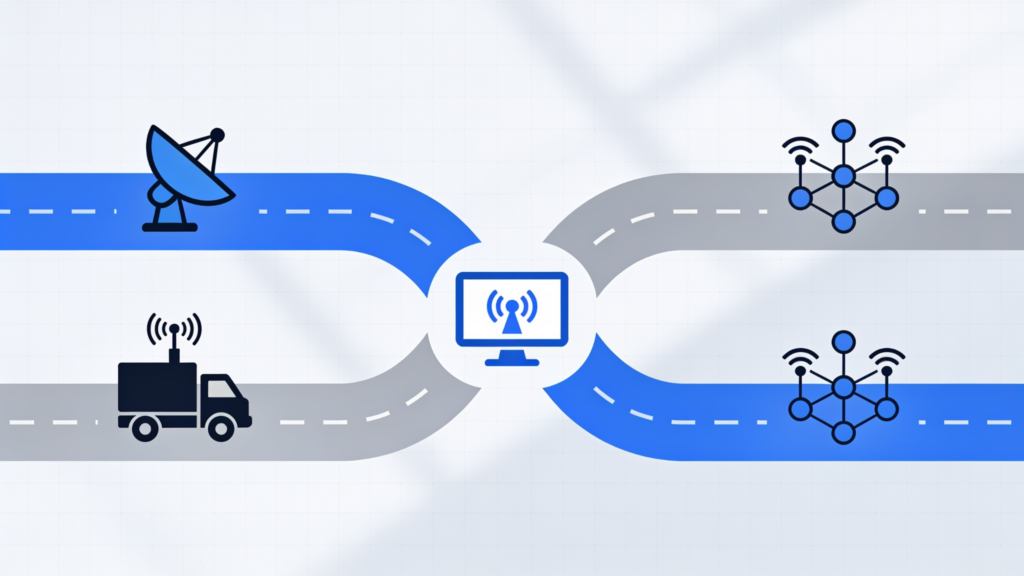
Short answer: for the large majority of live sports coverage, bonded IP contribution is already reliable enough to replace satellite, and has been the default choice for several years. The exceptions are narrower and more specific than most production teams assume — a handful of dense, remote, or unpredictable environments where satellite (or a more advanced bonded system) still has a real edge. This guide breaks down exactly where that line sits, what broadcast-grade reliability actually requires over IP, and how the two paths compare on the factors that matter for a live sports production.
What Reliable Enough Actually Requires
Reliability isn’t a single number — it’s a combination of uplink resilience, deployment speed, and consistency across venues. A satellite dish sidesteps local network congestion entirely, which is why it earned decades of trust for high-stakes broadcasts. But an IP-based system can match that resilience through bonded transmission: combining multiple independent connections into a single managed stream, run through a transport protocol built specifically for video rather than general internet traffic. When done properly, a dropped connection gets absorbed by the others before a viewer notices, which is the actual bar broadcast-grade needs to clear.
That definition also has to hold up under staffing and scale pressure, not just under a network stress test. Most live sports productions today run leaner crews than they did a decade ago, and a growing share of events need to feed a linear broadcast, a streaming platform, and social clips at the same time. A contribution method that requires a dedicated operator and only produces one feed for one destination is solving a narrower problem than the one most broadcasters actually have.
Where Satellite Still Wins
Satellite hasn’t been made obsolete, and it would be inaccurate to suggest otherwise. It remains the stronger choice for wide-area coverage in regions with limited cellular infrastructure, for major events with locked-in logistics planned well in advance, and for productions that specifically require independent path redundancy alongside any IP workflow. What’s changed is the size of that list — it used to cover most live sports production, and now it covers a much narrower slice of it.
Weather is worth calling out specifically, since it’s the one variable that can work against satellite even when everything else about a deployment goes to plan. Heavy rain and adverse atmospheric conditions can degrade a satellite signal, often at the exact moments — a storm rolling into a stadium, a championship game running late into changing conditions — when coverage matters most. Bonded IP isn’t immune to weather either, but its multi-path design gives it more room to route around a single degraded connection than a fixed dish pointed at one satellite.
The Environments That Still Test Bonded IP
Even a well-built bonded system has a specific set of conditions where it gets pushed hardest: a packed stadium bowl where thousands of phones compete for the same cell towers, a remote mountain venue with marginal signal, or a breaking-news location where conditions are unknown until the crew arrives. Standard bonding manages routine congestion well, but it operates from a fixed set of pre-installed carriers — under fast-shifting conditions, it can only redistribute load away from a degrading connection, not replace it with something better.
Do you know The Night I Stopped Babysitting the Signal? It’s a first-hand account of exactly this transition, worth reading if you want the operational reality rather than the spec sheet.
How Predictive Connectivity Closes the Gap
The newest layer addressing that gap is predictive, AI-driven carrier selection: software that analyzes live network performance alongside historical data from past sessions at similar locations, then switches to a better-performing connection before quality actually drops, rather than reacting once it does. That shift — from reactive to predictive — is specifically what’s narrowing the remaining list of scenarios where satellite still has an edge.
For more on the mechanics of bonded cellular transmission and how it holds up under network pressure, see 5G and Live Video Contribution: What Broadcasters Need to Know About Bonded Cellular Transmission.
Where LiveU Fits
LiveU is one of the more established vendors addressing this specific gap. Its bonding layer, LRT, handles packet ordering and adaptive bitrate across every active connection — the baseline capability any credible bonded system needs. LiveU IQ builds on that with a predictive layer, drawing on live monitoring plus historical performance data from a large pool of past sessions to switch to a better-performing carrier via eSIM ahead of a quality drop.
Two field deployments illustrate the practical range of that approach. A multi-hour endurance broadcast run through tunnels, heavy tree cover, and fast-moving camera positions is close to a worst-case scenario for cellular reliability, and it’s the kind of environment predictive carrier-switching was specifically built to handle. Separately, a horse-racing network eliminated satellite and OB trucks across eight venues by moving to an IP-based workflow, reporting cost reductions of close to 80% at its most remote locations. Together, those two cases cover both ends of the reliability question this guide opened with — the hardest live conditions, and the clearest financial case for making the switch at scale.
| Capability | What It Does | Reported Result |
| LRT (LiveU Reliable Transport) | Bonds multiple cellular and IP connections into a single managed stream; handles packet ordering and adaptive bitrate | Baseline reliability layer across LiveU’s field unit lineup |
| LiveU IQ | Adds predictive, AI-driven carrier selection using live and historical performance data; switches connections via eSIM before quality drops | Purpose-built for high-interference environments such as tunnels and dense crowds |
| LU900Q | Field unit with LiveU IQ built in natively | Used in a multi-hour endurance broadcast through tunnels and heavy tree cover |
| IP-based multi-venue rollout | Replaced satellite and OB trucks across eight venues for a horse-racing network | Cost reductions of close to 80% at the most remote locations |
Bottom Line
For live sports coverage generally, bonded IP is reliable enough to be the default, and has been for some time. The remaining cases where satellite (or a more advanced predictive bonded system) still matters are specific and shrinking: extremely dense venues, remote or marginal-coverage locations, and productions with a contractual need for guaranteed independent capacity. Any team still defaulting to satellite for coverage outside that narrow list is likely paying for reliability it no longer needs to buy separately.
FAQs
Q: Is bonded IP actually as reliable as satellite for live sports?
A: For the large majority of live sports coverage, yes. The gap that remains is concentrated in dense crowds, remote or marginal-coverage venues, and situations where network conditions can’t be predicted ahead of time.
Q: When does satellite still make more sense than IP for sports coverage?
A: When the venue is in a region with limited cellular infrastructure, when the event is large and planned far enough in advance to justify the cost, or when a production specifically requires guaranteed, independent path redundancy.
Q: How does LiveU IQ differ from standard bonded IP transmission?
A: Standard bonding works with a fixed set of pre-installed carriers and redistributes bandwidth when one degrades. LiveU IQ adds a predictive layer that analyzes live and historical data to switch to a better-performing carrier via eSIM before quality actually drops.
Q: Does switching to LiveU’s platform require replacing existing field equipment?
A: Not always. LiveU IQ ships natively on newer units like the LU900Q, but it can also be layered onto some existing multi-camera units already in a broadcaster’s inventory, which changes the payback timeline for organizations that recently invested in field gear.