Occasional Use for Live Sports: A Risk Framework Before You Book Anything
Live sports Occasional Use (OU) distribution fails at the coordination layer, not the technology layer — the fix is picking a provider who owns and monitors the full signal chain end to end, and pressure-testing that claim before the event, not during it. Here’s the framework rights holders and distribution execs should run through before locking in a provider.
The Event Doesn’t Care About Your Infrastructure Gaps
A qualifier, a tournament weekend, or a single high-stakes match will expose every weak point in a distribution chain in real time, in front of the exact sponsors, rights holders, and partners a broadcaster can least afford to disappoint. For executives responsible for rights delivery and revenue, OU isn’t a niche engineering detail. It’s a strategic risk category that either gets a deliberate operational model or gets found out live.
Two default approaches carry outsized downside. Speed-first deployment — get a stream live on a public platform fast, sort out the complications later — routinely produces unreliable geo-controls, branding gaps, and content landing in territories where exclusivity was sold elsewhere. Over-engineering per event — a bespoke build for every one-off occasion — is slow, expensive, and leaves nothing reusable for the next event. Neither scales, and neither protects the contractual obligations that actually matter.
Where Live Broadcasts Actually Fail
The gear behind live sports distribution is mature; satellites, encoders, and IP contribution protocols all work reliably in isolation. What fails is the layer above the gear: who owns which segment of the chain, who can see the whole path at once, and who makes the call when something breaks at 9pm mid-fixture.
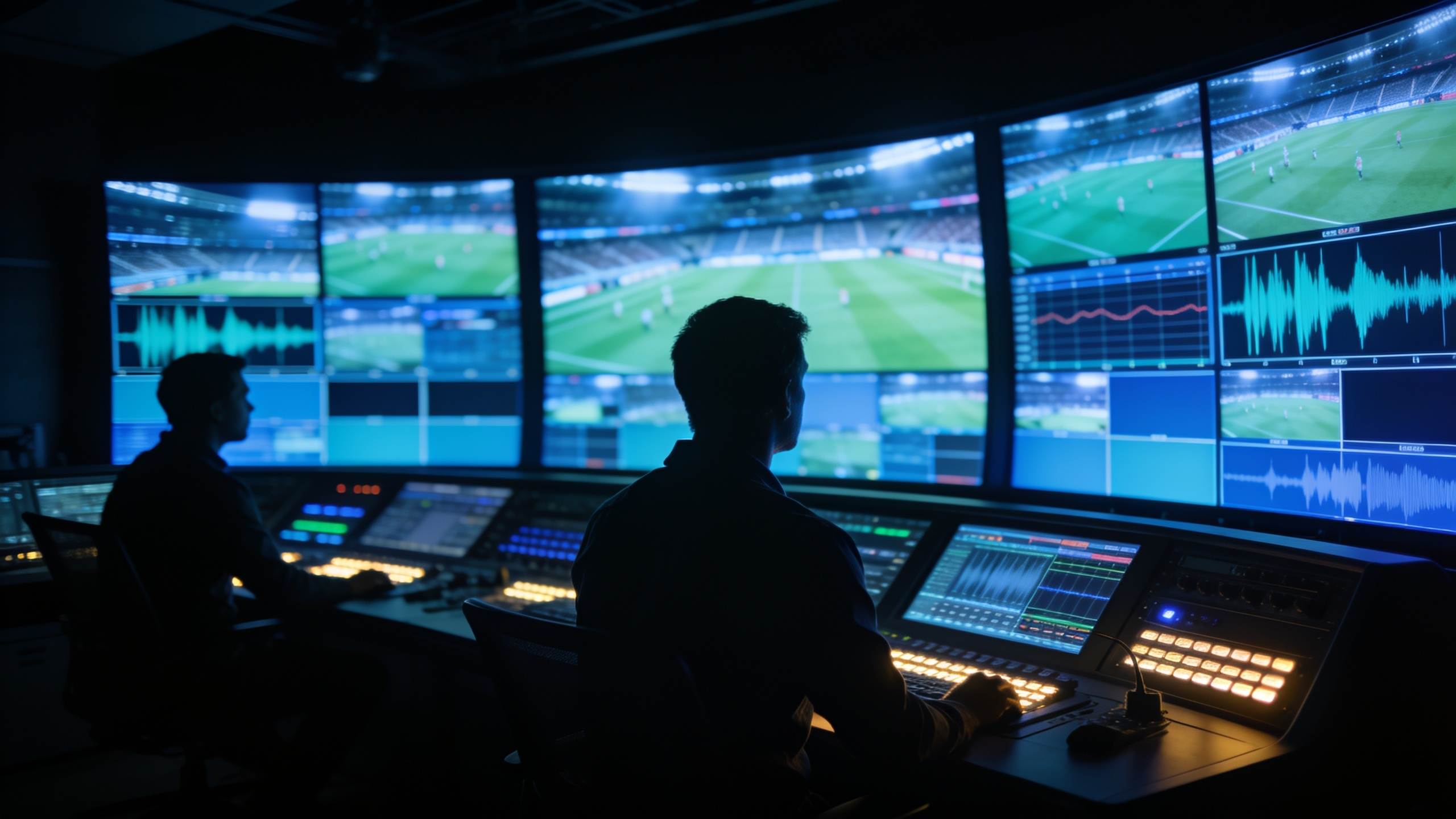
Four points deserve more scrutiny than they usually get. Contribution and ingest is where fragility starts — a feed dependent on a single connectivity path makes everything downstream irrelevant if it drops. Rights enforcement at the packaging layer is where legal exposure lives; geo-blocking and DRM need validation against the actual contractual territory map before broadcast, not after a complaint arrives. Last-mile delivery is where viewer experience is won or lost, and multi-CDN routing with active steering is what keeps a regional outage from becoming a public failure. And 24/7 human accountability is the one layer no dashboard replaces — automated alerts are useful, but a staffed NOC with a real escalation path is what turns an incident into a footnote instead of the story of the event.
Do you know Getting a Live Broadcast From a Venue to the World: What Happens Between Camera and Screen? It walks through the full six-stage journey a signal takes before any of this risk framework even applies.
Why Hybrid Beats Cloud-Only or Satellite-Only
The operational standard for high-consequence live sports is a hybrid model: teleport-grade ingest paired with cloud-native playout and delivery. Cloud-only setups are fast to deploy but can lack the signal reliability and latency control broadcast-grade sport demands at the contribution layer. Satellite-only setups are reliable but slow and expensive to flex event-to-event. Combining both addresses the actual tension in OU work — reliability without sacrificing the speed a one-off booking needs.
Booking itself is worth scrutinizing too. OU is fundamentally a usage-based service model, not a permanent circuit — a federation running six events a year shouldn’t be paying for a 365-day uplink. But usage-based pricing only pays off if the provider can actually confirm and activate capacity on short notice, which is a fair question to put to any vendor before signing.
Scope matters as much as pricing. A full OU engagement should cover the entire signal chain under one coordinated service — contribution transport from the venue, teleport reception and processing, onward satellite distribution, and streaming delivery where relevant — rather than being pieced together from separate bookings with separate vendors for each leg. The fewer handoffs between parties during the live event itself, the fewer places where accountability becomes ambiguous the moment something goes sideways.
Comparing Three Approaches to Live Sports OU
Three providers currently represent distinct starting points for OU and managed live event services.
| Evaluation dimension | Amagi | Globecast | iKOMG |
|---|---|---|---|
| Core positioning | Cloud-native, streaming-first (Amagi LIVE) | Large-scale global managed satellite & fiber services | Hybrid teleport + IP/cloud, single managed OU agreement |
| Owns teleport infrastructure | No — cloud broadcast platform | Yes — extensive global footprint | Yes — dual European & Middle East facilities |
| Satellite + streaming from one session | Streaming-first, satellite not native | Available, less platform-integrated | Yes — same session covers both |
| 24/7 NOC monitoring | Available | Core strength at scale | Yes — staffed across both teleports |
| AI highlight clipping in-service | Not a core OU feature | Not a core OU feature | Yes — iKOCLIPS, sub-30-second turnaround |
| Best fit | Cloud-first, streaming-heavy rights holders | Large enterprise, high-volume global events | Hybrid satellite + streaming, mid-scale rights holders wanting one vendor |
None of the three is a universal best answer — a rights holder running purely streaming-native distribution gains little from teleport ownership, while one distributing to traditional broadcast affiliates in multiple territories loses real redundancy without it.
What to Verify Before You Sign
Ask any OU vendor four direct questions rather than relying on their pitch deck: do they own and operate their own teleport facilities, or lease capacity from someone else? Do they have facility-level redundancy, not just equipment redundancy? What real-time monitoring runs across the full chain, from venue to viewer, not just at the uplink? And is failover pre-configured before the event starts, or reactive once something’s already gone wrong? A rights-preflight check against the actual territory map should also be a standard, documented part of the pre-event checklist — not something confirmed after a complaint from a rights partner in the wrong territory.
The clearest way to test any of this before committing budget is a full end-to-end stress exercise conducted at least a week ahead of the event: walking through ingest, DRM validation, adaptive bitrate playback on real devices, CDN load testing, and a simulated failover. If a vendor can’t complete or document that exercise clearly on request, that’s the answer to whether their setup is actually ready, regardless of what the contract says.
Read to find out how live sports actually reaches global audiences without any single company owning the satellites carrying it — this episode breaks down the same OU risk model in audio form, including what a failed transmission actually costs a rights holder in penalties and renewal leverage.
Bottom Line
Every live sports event, regardless of size, falls into the Occasional Use category — the infrastructure requirements don’t scale down for a smaller match, only the stakes do. The question for rights holders isn’t whether the next event justifies broadcast-grade OU infrastructure. It’s whether the operational model can survive contact with a live, unscripted event, and whether that’s been tested before the whistle blows rather than discovered during it.
FAQ
Q: What is Occasional Use (OU) in live sports broadcasting?
A: OU is a booking model where satellite capacity and managed broadcast infrastructure are contracted for a specific event window rather than maintained as a permanent circuit — the standard approach for sports federations and production companies that broadcast on an irregular schedule rather than continuously.
Q: What’s the single biggest OU failure mode executives underestimate?
A: Rights and territorial enforcement, not signal loss. A distribution glitch that places content in a rights-restricted market is a contract breach, not a technical hiccup, and it’s usually discovered by a rights partner rather than caught internally.
Q: Is a hybrid teleport-plus-cloud model always the right call?
A: For high-consequence live sport, generally yes — it balances the signal reliability of physical infrastructure with the flexibility of cloud delivery. A purely digital-native, low-stakes stream may not need the teleport side at all.
Q: How does iKOMG’s OU offering compare to Amagi and Globecast?
A: iKOMG combines owned teleport infrastructure in Europe and the Middle East with IP and cloud delivery under one managed agreement, positioning it between Amagi’s cloud-native streaming focus and Globecast’s larger-scale traditional satellite footprint. Amagi suits streaming-first rights holders; Globecast suits high-volume global enterprise distribution; iKOMG suits hybrid satellite-plus-streaming needs at a more consolidated, mid-scale level.
Q: What does iKOCLIPS add to an OU engagement?
A: iKOCLIPS is iKOMG’s AI-powered highlight clipping tool, generating short-form clips in under 30 seconds during the live window — a content-generation layer most OU competitors don’t build directly into the same service stack.
Q: Does iKOMG’s OU service require a long lead time to book?
A: iKOMG advertises instant deployment with booking confirmation within minutes for standard events; complex multi-territory rights setups reasonably need more lead time for the rights-preflight and ingest validation steps regardless of vendor.