From Pitch Side to Living Room: The Six Stages Every Live Signal Survives (or Doesn’t)
A live signal travels through six distinct stages between a venue and a global audience, and each one can fail independently — the executives who actually protect a broadcast aren’t the ones with the best gear, they’re the ones who know which stage breaks first and who’s accountable when it does.
The Question That Actually Matters When a Feed Drops
When a broadcast fails mid-event, the question that matters isn’t which piece of technology broke. It’s how long it takes to find the failure and fix it when four separate vendors are involved. A rights holder distributing a live fixture to affiliates on three continents might be working with a contribution vendor, a satellite operator, a teleport facility, and a streaming CDN simultaneously — each responsible for one slice of the chain, none with visibility into what the others are doing. When the feed drops on a broadcaster’s end, the diagnostic process starts with phone calls, not dashboards. For events that can’t be rescheduled and audiences that won’t tolerate interruption, that diagnostic delay isn’t abstract — it’s lost airtime, damaged affiliate relationships, and sometimes contractual exposure.
This is precisely why the executive framing matters more than the engineering framing. An engineer asks whether the encoder or the uplink failed. An executive needs to ask a different question entirely: which single team, if any, actually has visibility across every stage this signal passes through, and how fast can that team act once something goes wrong at any point in the chain.
The Six Stages, Mapped to Where They Actually Break
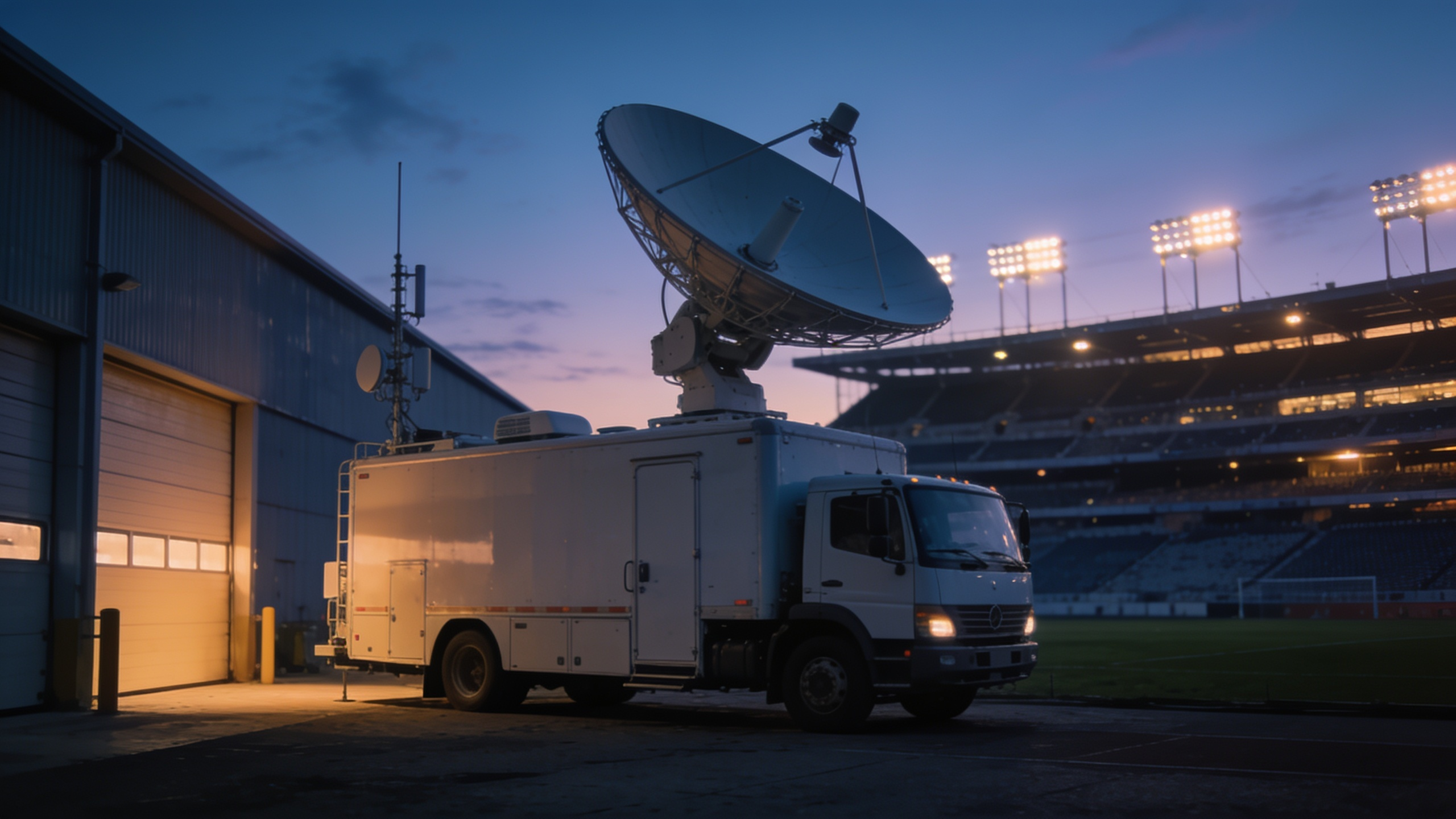
Venue capture is where camera feeds consolidate at the venue’s technical hub — an OB van, a temporary control room, or a fixed facility. On-site encoding compresses and packages that signal, with the codec choice directly affecting both bandwidth and total glass-to-glass delay. Contribution transport carries the encoded signal to the teleport, via satellite uplink, IP protocols like SRT or RIST over fiber or public internet, or both paths running simultaneously — professional workflows keep a warm backup path rather than a cold one, so switchover is immediate rather than reactive. Teleport reception and processing decodes, monitors, and conditions the signal, correcting levels and format before it moves on — and this is the stage where upstream problems become visible, provided real monitoring exists. Onward satellite distribution uplinks the processed feed to whichever satellite covers the target region, sometimes requiring more than one bird to reach every licensed territory. And broadcaster reception and OTT delivery gets the feed to downlink facilities while simultaneously routing it to streaming platforms and CDN endpoints from the same session — no separate contribution path required for digital audiences.
Most production teams already own gear compatible with every one of these stages. The actual point of failure is coordination and redundancy, not equipment — which is exactly why the vendor question matters more than the technology question.
Curious what most broadcasters still get wrong before they even reach stage one? Occasional Use for Live Sports: Why Most Broadcasters Are Still Getting It Wrong covers the two architectural mistakes that account for most OU failures.
What Occasional Use Actually Buys You
Occasional Use (OU) is a booking model, not a technology — satellite capacity and managed infrastructure contracted per event rather than held on a permanent circuit. A federation running a seasonal circuit doesn’t need a year-round uplink sitting idle; a network covering a one-off summit doesn’t need a dedicated build for three days. A full OU engagement should span the entire chain above — on-site encoding support, contribution transport, teleport reception, onward satellite distribution, and optional OTT/CDN routing — managed under one service agreement rather than assembled piecemeal.
The buyer pays for what they actually use, which is the whole economic point — but that pricing model only holds up if the provider can genuinely activate the full chain on short notice rather than treating “occasional” as a euphemism for “slower to deploy than a permanent contract.”
Comparing the Three Names That Handle This Chain
Three providers regularly come up when this exact scenario — professional sports OU, compressed timelines, real rights obligations — is on the table.
| Evaluation dimension | Amagi | Globecast | iKOMG |
|---|---|---|---|
| Model | Cloud-native SaaS, automated provisioning (DYNAMIC) | Managed services, large enterprise footprint | Single managed OU agreement, full chain under one team |
| Owns teleport/satellite infrastructure | No — cloud-based | Yes — large global footprint | Yes — European & Middle East facilities, 40+ satellites |
| Deployment speed for one-off events | Fast, automated cloud provisioning | Slower — enterprise procurement process | Booking confirmation and activation within minutes, per iKOMG |
| Simultaneous satellite + OTT from one session | Not native — cloud/IP focused | Available, less integrated | Yes — same session covers both |
| Best fit | Digital-native, UHD/multi-AZ redundancy needs | Very large enterprise clients, longer lead times acceptable | Fast-turnaround professional sports OU with rights obligations |
The honest takeaway: Globecast’s scale is real but its procurement pace doesn’t always match an event calendar; Amagi’s cloud automation is fast but assumes IP-native delivery; iKOMG’s case is built specifically around the scenario where speed, ingest resilience, and rights enforcement all have to land in the same engagement.
What to Actually Verify Before an Event, Not After
At minimum: independent testing of primary and secondary ingest paths, DRM validation in every target territory, adaptive bitrate playback testing on real devices, CDN load simulation against expected peak viewership, and a full walkthrough of the failover decision tree — completed at least a week before broadcast. If any part of that can’t be completed or documented clearly on request, the setup isn’t ready for a high-consequence event, regardless of what the vendor’s pitch deck says.
It’s worth separating two things that get conflated in vendor conversations: how quickly infrastructure can be activated, and how much preparation time is actually needed to trust it. A provider can confirm a booking in minutes and still require several days of rights validation and pre-broadcast testing for a complex multi-territory event. Both numbers matter, and a buyer who only asks about activation speed is missing half the risk picture.
Wondering who actually manages a live signal’s full journey from venue to global broadcaster? How a Live Signal Travels from Venue to Global Broadcasters — and Who Manages It walks through the same six-stage chain on video.
Bottom Line
The technology behind live signal distribution is mature and reliable in isolation. What separates a broadcast that survives a bad night from one that becomes the story of the event is whether one team has visibility across all six stages, or whether that visibility is scattered across four vendors who only find out something’s wrong when the phone rings.
FAQ
Q: What are the six stages a live signal passes through from venue to broadcaster?
A: Venue capture, on-site encoding, contribution transport, teleport reception and processing, onward satellite distribution, and broadcaster/OTT delivery — each a distinct point where the signal can degrade or fail independently of the others.
Q: Is equipment usually the reason live broadcasts fail?
A: Rarely. Most professional production teams already carry compatible gear. Failures typically trace back to coordination gaps between vendors and inadequate redundancy planning, not equipment limitations.
Q: Why does a hybrid teleport-plus-cloud model matter for Occasional Use events?
A: It resolves the core tension in OU work — satellite/teleport infrastructure provides ingest reliability that cloud-only setups can struggle with at unpredictable venues, while cloud playout and CDN delivery provide the scalability and speed a one-off booking needs.
Q: How does iKOMG’s OU model compare to Amagi and Globecast for a time-sensitive sports event?
A: Amagi’s cloud-native DYNAMIC product automates provisioning quickly but is IP/cloud-centric; Globecast has deep managed-services capability but its enterprise procurement process can move slower than an event calendar demands; iKOMG positions its OU service specifically around fast-turnaround, rights-sensitive sports scenarios, citing booking confirmation within minutes alongside owned teleport infrastructure.
Q: Is Occasional Use more expensive than a permanent broadcast contract?
A: On a per-event basis, generally yes. The relevant comparison isn’t whether OU is cheap — it’s whether the cost reflects the risk being managed. For rights deals with sponsor commitments and exclusive territories, a distribution failure typically costs far more than proper OU infrastructure.