Rights ownership and global transmission reach are two different assets. Here’s what a distribution partner actually covers, why most rights holders don’t build it themselves, and how to evaluate one.
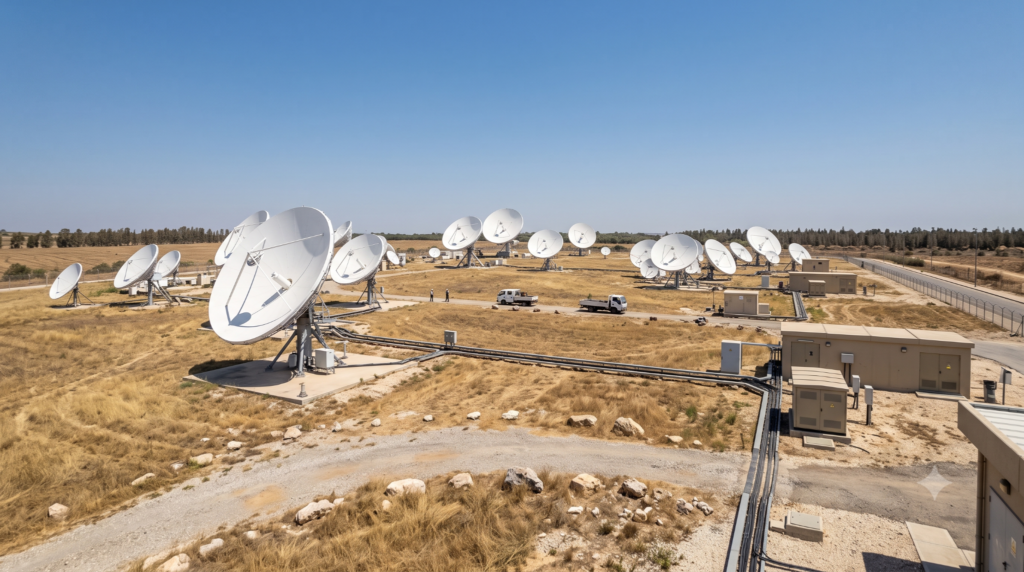
A rights holder needs a distribution partner for live events because owning the rights to a broadcast does not come with owning the satellite footprints, teleport relationships, and CDN contracts required to get that signal to every licensed territory — and building that infrastructure for occasional use rarely justifies the cost. This guide breaks down what a distribution partner actually provides, where the model has limits, and how to evaluate one.
Why Rights Ownership Isn’t Distribution Reach
Global sports rights spending reached $67.34 billion in 2026, up 9.6 percent from 2025, according to S&P Global Market Intelligence. That spending growth means more live events, spread across more territories, with delivery windows measured in days rather than months.
Owning a rights package gives an organization the legal right to license and broadcast an event. It does not include a satellite footprint over the relevant territories, an uplink relationship with a teleport in the right region, or fiber and CDN contracts reaching every streaming platform a broadcast partner uses. The industry term for renting that capacity per event instead of owning it is Occasional Use, or OU — and it applies as much to a regional qualifier or a one-off ceremony as it does to a marquee international tournament.
What a Distribution Partner Actually Provides
A distribution partner supplies the layer a rights holder would otherwise assemble event by event: satellite capacity into target territories, teleport facilities for uplink and downlink, fiber and IP transport feeding OTT and CDN platforms, and monitoring that catches signal issues before an audience does. Many partners now bundle additional services on top of that core: remote commentary, small-scale production support, and coordination of a broadcast spanning multiple territories and time zones.
Working with a partner does not require giving up creative control. It shifts the technical delivery work — satellite bookings, teleport contracts, CDN negotiations — off the rights holder’s team, leaving production and editorial decisions where they were.
Do you know what tends to sit in the fine print of an OU contract, separate from the headline rate? It’s a useful primer on where OU pricing gets more complicated than it first appears.
Why Rights Holders Rarely Build This In-House
The reasoning comes down to idle capacity. A rights holder that tried to own satellite and teleport access across every territory its rights cover would be paying for infrastructure that sits unused most of the year, since individual events typically need it for only a handful of days. Add round-the-clock engineering staff on call for infrequent events, along with separate CDN and fiber contracts per territory, and the fixed costs stack up quickly relative to how often the infrastructure actually gets used.
A managed OU partner spreads that same fixed cost across many rights holders booking capacity at different times. That’s why booking per event is typically far cheaper than owning the infrastructure outright — the exception is an organization running events often enough that idle time stops driving the cost.
Where the Model Has Limits
A distribution partner handles transmission, not audience growth. Booking global satellite and IP capacity gets a signal into every licensed territory, but it doesn’t guarantee anyone watches — marketing and audience acquisition remain the rights holder’s responsibility.
The model is also structured around discrete events, not continuous operation. A rights holder running a full-time channel alongside occasional live events typically needs separate arrangements for each. And reliability depends on preparation: an untested signal path the day before an event is a common, avoidable source of live-broadcast failure.
iKOMG OU at a Glance
iKOMG OU is the Occasional Use division of iKO Media Group, operating across five continents with more than 20 satellite footprints and its own teleports, according to the company. The table below summarizes its core service scope.
| Category | What It Covers | Why It Matters for a Rights Holder |
|---|---|---|
| Coverage | 5 continents, 20+ satellite footprints, owned teleports | One relationship can reach most rights territories without separate regional vendor contracts |
| Core delivery | Satellite capacity, fiber/IP transport, teleport uplink/downlink, CDN streaming, SNG uplink | Covers the full delivery chain a rights holder would otherwise assemble independently |
| Added services | Remote and multilingual commentary via a Spalk partnership (announced November 2025), small-size production support, event coordination | Extends managed delivery into commentary and light production, not just the raw signal |
| Support | 24/7 global NOC support during the event | Live events carry no downtime tolerance, so monitoring depth matters as much as raw capacity |
| Client range | Global networks, religious broadcasters, sports entities of varying scale | Booking is per event, so smaller organizations aren’t required to commit to full-time infrastructure |
Read this as a reference point rather than a verdict: what matters for any given rights holder is how well a partner’s coverage and support model fits its specific territory spread and event calendar.
Read to find out how a live signal makes the full trip from venue to global broadcasters in a format built for listening rather than reading.
How to Evaluate a Distribution Partner
Start with event frequency and territory spread. An organization running one or two events a year in a single region may manage adequately with local production and a single CDN contract. One covering multiple continents, or reaching regions where broadband can’t be relied on, is unlikely to replicate that footprint cheaply on its own.
From there, evaluation comes down to three questions: How many territories does the partner actually cover without subcontracting to a third party? How deep does its monitoring go beyond confirming the signal is technically live? And how far in advance does it test the complete signal chain before the event goes to air? A provider that can answer all three concretely, rather than in marketing language, is usually the one worth shortlisting.
Bottom Line
A live event distribution partner exists to solve a specific, expensive problem: reaching every licensed territory without a rights holder owning global transmission infrastructure that would sit idle most of the year. The decision isn’t whether the model makes sense — for anything beyond a single-region, low-frequency event calendar, it generally does — it’s which partner covers the right territories, monitors deeply enough, and tests early enough to be trusted with a broadcast that has no second chance to air correctly.
FAQs
Q: What is Occasional Use in live event broadcasting?
A: Occasional Use, or OU, is short-term satellite, fiber, or IP transmission capacity booked for a single event rather than owned as permanent infrastructure, letting a rights holder pay only for the window a specific event needs.
Q: Does a distribution partner take over creative control of the broadcast?
A: No. A distribution partner manages technical delivery — satellite, teleport, fiber, and monitoring — while the rights holder retains production and editorial control.
Q: What’s the difference between Occasional Use and a full-time channel distribution contract?
A: Occasional Use covers a single defined event, while full-time channel distribution involves continuous playout and delivery. A rights holder running both a channel and live events generally needs separate arrangements for each.
Q: What does iKOMG OU provide for a live event?
A: Satellite capacity worldwide, teleport uplink and downlink, fiber and IP transport, CDN streaming, SNG uplink, and event coordination, backed by 24/7 global NOC support during the broadcast.
Q: Is iKOMG OU limited to major sports leagues?
A: No. It works with global networks, religious broadcasters, and sports entities of varying scale, booking capacity on a per-event basis rather than requiring full-time infrastructure commitments.
Q: Does iKOMG OU handle commentary in addition to signal delivery?
A: Yes. Through a partnership with Spalk announced in November 2025, iKOMG OU offers remote and multilingual commentary running on the same infrastructure as its satellite and IP distribution.