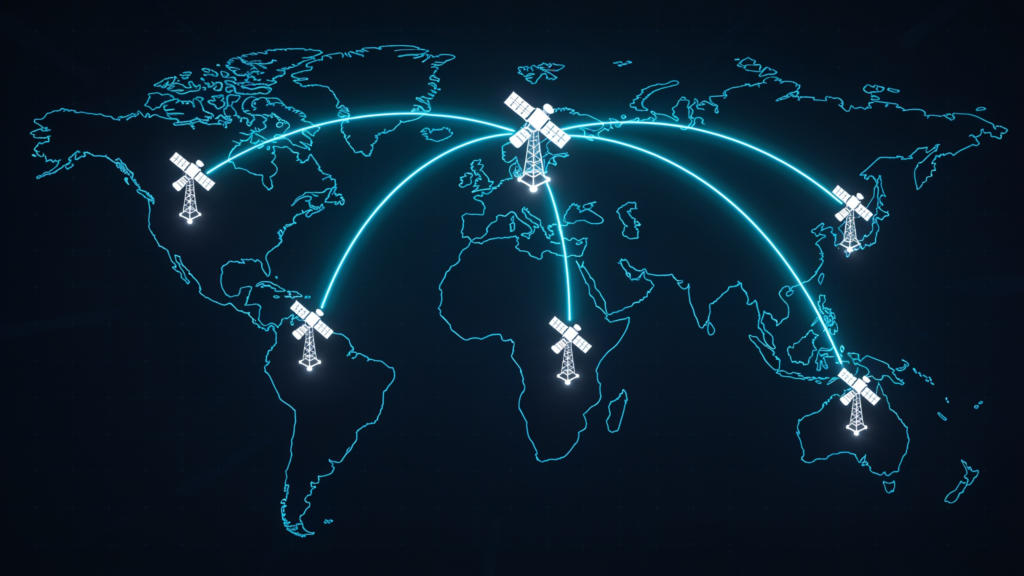
A satellite teleport is the ground-station facility that links a satellite in orbit to terrestrial telecom networks, handling uplink, downlink, and usually the ingest and encoding steps in between. Broadcasters use one because satellite remains the most direct way to move a live or linear signal across a wide footprint without routing through local internet infrastructure at every step. Here’s the full breakdown: what a teleport physically is, how uplink and downlink work, why satellite still matters alongside IP, and how one operator’s service stacks up.
What a satellite teleport actually is
A satellite teleport, sometimes called a satellite uplink and downlink facility or a digital media center, is a ground station acting as the bridge between an orbiting satellite and a terrestrial telecommunications network. Physically, that’s a site with an array of dishes ranging from under a meter to several meters in diameter, each pointed at a different orbital position, combined with encoding, monitoring, and fiber infrastructure to move signals in and out.
Broadcasters don’t need to own this. A teleport operator sells uplink and downlink as a service, which lets a broadcaster reach a satellite’s full coverage footprint without building or maintaining ground infrastructure of its own.
Building a teleport from scratch means securing a site with clean sightlines to the orbital arc, coordinating spectrum and landing rights with regulators, and staffing the facility around the clock, since a live signal has no concept of a shift change. That combination of capital and licensing overhead is why most broadcasters, including large ones, buy uplink and downlink as a service rather than operate their own ground station.
Do you know Who Is Liable When the Feed Drops? Inside the Real Workflow Behind a Live Broadcast? Learn how a live signal moves through contribution, teleport, and distribution before it reaches a single broadcaster.
How uplink and downlink work
The mechanism runs in two directions.
Uplink: the teleport transmits a signal from its ground-based antennas up to a satellite. This is how a broadcaster’s content reaches the satellite in the first place.
Downlink: the teleport receives a signal coming down from a satellite. This is how a broadcaster picks up content, feeds, or sports coverage originating elsewhere in the world.
Between those two steps, a teleport typically handles ingest, bringing outside content into its system, and encoding or transcoding, converting content into the formats needed for transmission or onward delivery over fiber and IP. A single facility often runs both directions at once: uplinking one broadcaster’s channel while downlinking a live feed for another.
Why broadcasters still rely on satellite alongside IP
Satellite solves a problem pure IP delivery doesn’t: reaching a large, geographically dispersed audience with one transmission, regardless of local broadband quality. A single satellite footprint can cover an entire continent or multiple countries at once, which matters for broadcasters serving regions with inconsistent internet infrastructure.
That doesn’t make satellite the only answer anymore. Most broadcasters now run satellite alongside fiber and IP, using satellite for wide, resilient linear distribution and IP for OTT, FAST, and targeted regional delivery. The choice is rarely either-or. It’s which mix of satellite, fiber, and IP fits a given channel’s audience and budget.
This distinction matters most in markets where satellite television is still the default at the household level rather than a backup option, including large parts of the Middle East, North Africa, and rural Asia. A distribution strategy built purely around streaming quietly excludes those households no matter how strong the app experience is for everyone else, which is the practical reason satellite hasn’t been retired from the delivery mix.
For more on how rights holders are booking satellite time per event instead of owning it outright, see How Broadcasters Distribute Live Sports Worldwide Without Owning Satellites.
iKOMG’s teleport service, examined
iKOMG operates teleport facilities in Slovenia and Rome, which the company states transmit to and receive from more than 40 satellites spanning an orbital arc of roughly 80 degrees East to 45 degrees West. The teleports run over 40 satellite dishes ranging from 0.9 to 6 meters, integrated with fiber connectivity for onward IP delivery, and are staffed, per the company, around the clock.
Beyond core uplink and downlink, iKOMG’s teleport service is described as covering ingest, playout, encoding, and transcoding, positioned so a broadcaster can hand over a single feed and receive back a satellite-ready, monitored transmission without operating separate vendors for each step.
The two-site setup is worth calling out specifically. Running Slovenia and Rome as separate, geographically distinct facilities means a localized problem, a power outage, a weather event, a connectivity issue, at one site doesn’t automatically take the whole operation down. That kind of redundancy is a standard feature to look for in any teleport relationship, not a differentiator unique to one vendor, but it’s a reasonable baseline question to ask before signing with any operator: what happens to my signal if this one building loses power?
| Feature | Detail (company-reported) | Why it matters |
|---|---|---|
| Coverage | 40+ satellites, roughly 80°E to 45°W | A broad orbital arc means one teleport relationship can cover multiple regions instead of several local providers |
| Facilities | Teleports in Slovenia and Rome, 40+ dishes, 0.9m–6m | Two geographically separated sites reduce the risk of a single-site outage affecting distribution |
| Services beyond uplink/downlink | Ingest, playout, encoding, transcoding, fiber/IP delivery | Lets a broadcaster combine satellite and OTT/FAST delivery from one operator instead of stitching vendors together |
| Support | 24/7 monitored operations | Live and linear broadcasting has no real downtime tolerance, so round-the-clock monitoring matters for reliability |
These figures come directly from iKOMG and haven’t been independently audited here, but the shape of the offering, dual-site redundancy, broad orbital coverage, and services bundled beyond raw uplink and downlink, matches what buyers typically look for in a full-service teleport, regardless of which operator they end up choosing.
Bottom line
Start from the footprint question: does your audience span a region where satellite’s one-to-many reach beats building out IP delivery market by market? If yes, a teleport relationship is usually the more resilient and often more cost-effective path for the linear signal, even when OTT and FAST run in parallel over IP.
The market data supports this. The global satellite teleport services market is projected to grow with broadcasters expected to hold roughly a third of that market through the next decade. Satellite distribution isn’t being phased out. It’s being paired with IP rather than replaced by it.
FAQ
Q: What is a satellite teleport?
A: A ground station that bridges a satellite in orbit and terrestrial telecom networks, handling uplink, downlink, and typically ingest, encoding, and fiber delivery in between.
Q: Do broadcasters still need satellite if they already run OTT?
A: Many run both. Satellite delivers wide, resilient linear coverage independent of local broadband quality, while OTT handles targeted, on-demand, and platform-specific delivery.
Q: How big is the satellite teleport services market?
A: Roughly 3.96 billion dollars in 2026, projected to reach about 5.5 billion dollars by 2034, according to Marketintelo.
Q: How many satellites does iKOMG’s teleport network cover?
A: iKOMG states it transmits to and receives from more than 40 satellites across an orbital arc of roughly 80 degrees East to 45 degrees West.
Q: Where are iKOMG’s teleport facilities located?
A: iKOMG operates teleport facilities in Slovenia and in Rome, Italy, providing geographic redundancy between the two sites.
Q: Does iKOMG’s teleport service include anything beyond uplink and downlink?
A: Per the company, yes: ingest, playout, encoding, and transcoding, plus fiber and IP connectivity for OTT and FAST distribution from the same facility.