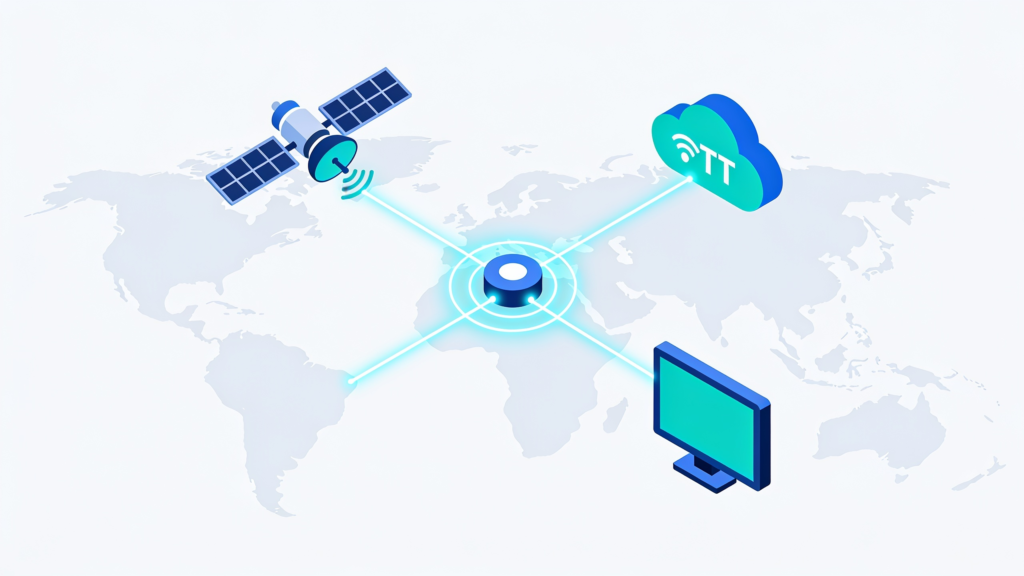
Yes — broadcasters can reach satellite, OTT, and FAST audiences at the same time, but only by routing one content feed through an aggregation and distribution layer that repackages it for each platform’s technical requirements at the point of delivery, rather than producing a separate feed for every destination. The nuance most operators miss: simultaneous does not mean identical. This guide breaks down what the pipeline actually looks like, what tends to break it, and how a managed distribution service fits into the picture.
Why This Has Become a Monetization Question, Not Just a Reach Question
FAST channel revenue in the US alone is projected to reach roughly $12 billion by 2027, according to research firm TBI. That figure changes the framing of simultaneous distribution: it stops being a reach exercise and becomes a monetization strategy, since every platform reached at launch rather than months later is inventory that starts earning immediately.
Without a shared aggregation and distribution layer, most broadcasters end up running separate vendors and workflows per platform, which slows launches and fragments ad monetization across disconnected systems. That fragmentation is the operational problem this guide is really about.
It’s also worth being clear about what simultaneous is not solving. It doesn’t remove the need for rights clearance, it doesn’t guarantee identical latency across every platform, and it doesn’t replace the ad operations work of actually selling the inventory a broader footprint creates. What it does solve is the mechanical problem of getting one piece of content technically ready for three very different destinations without rebuilding the pipeline every time a new platform gets added.
What Simultaneous Actually Means in Practice
Simultaneous multi-platform distribution means one piece of content — a live feed or a linear channel — reaches satellite, OTT, and FAST audiences within the same broadcast window, rather than being distributed to each platform in a separate pass. The source is ingested once. From there, the distribution layer produces the variants each platform needs:
- A satellite-ready transport stream for DTH and cable affiliates
- Adaptive bitrate renditions in HLS or DASH for OTT apps and websites
- An ad-supported version formatted for FAST channel guides on platforms like Roku and Fire TV
The content and the schedule stay aligned across all three. The technical packaging differs by design, not by accident.
How One Feed Becomes Three Outputs
The mechanism runs in three sequential stages.
Ingest: Live or file-based content enters the pipeline over standard protocols such as SRT, RIST, or MPEG-TS, frequently pulled from more than one teleport or fiber connection so a single point of failure doesn’t take the whole operation down.
Repackaging: The pipeline splits the single ingest into destination-specific outputs. Satellite transmission keeps the original transport stream structure intact for uplink. OTT and FAST require transcoding into HLS or DASH with adaptive bitrates so the stream adjusts to each viewer’s connection quality.
Ad decisioning: This step is applied per platform rather than uniformly. FAST channels typically use server-side or client-side ad insertion tied to a programmatic marketplace, while satellite distribution doesn’t carry that layer at all.
Once these three stages are automated end to end, adding a new distribution destination becomes a configuration change rather than a new production workflow — which is the operational payoff that makes the upfront pipeline investment worth it.
Do you know what it actually costs a channel operator when this stack is built wrong? It’s a useful read before evaluating vendors, since it walks through the four things that separate a workable distribution partnership from a costly one.
Where the Model Runs Into Real Limits
Simultaneous distribution isn’t free of trade-offs. Three limits show up consistently across broadcast operations.
Latency differs by platform: Satellite and OTT can run close to real time, but FAST channel guides sometimes introduce a short buffer to handle ad stitching, so live sports or breaking news can land on FAST a few seconds behind the other two feeds.
Rights and territory restrictions still apply per platform: A broadcaster cannot assume the same content is clearable everywhere at once just because the pipeline is technically capable of delivering it everywhere at once.
Vendor fragmentation multiplies operational overhead: Running satellite, OTT, and FAST from disconnected vendors means separate monitoring and support relationships for each platform, and a fault on one leg of distribution doesn’t always surface the same way on the other two.
For more on how that infrastructure question scales once a broadcaster is running more than one channel, see The Infrastructure Behind FAST Channel Growth, which covers the two infrastructure layers — delivery/monetization and operations — that FAST growth actually requires.
Where iKOMG Fits Into the Distribution Landscape
iKOMG’s content aggregation and distribution service is built around this exact problem: one ingest, multiple simultaneous outputs. The service pulls content from global sources over fiber and satellite teleport connectivity, repacks it to support SRT, RIST, and MPEG-TS alongside HLS and DASH streamtable feeds, and pushes it to satellite, OTT, and FAST destinations from the same pipeline. On the monetization side, iKOMG pairs this with CTV ad marketplace tools that connect ad inventory to multiple demand-side and supply-side platforms, aimed at selling FAST and OTT placements at scale rather than platform by platform.
| Capability | What it covers | Why it matters for simultaneous distribution |
|---|---|---|
| Ingest protocols | SRT, RIST, MPEG-TS, ASI, RTMP, plus fiber and satellite teleport connectivity | One ingest point instead of a separate feed per platform, cutting setup time for new launches |
| Distribution outputs | Satellite transport streams; HLS/DASH adaptive bitrate for OTT and FAST | Matches each platform’s technical requirements without re-engineering the source content |
| Monetization layer | CTV ad marketplace connecting multiple DSPs and SSPs (company-reported to help fill inventory at higher CPMs) | Turns simultaneous reach into simultaneous revenue rather than reach alone |
| Reported scale | Aggregates and distributes over 400 live TV channels worldwide (company-reported) | Signals a pipeline built for multi-channel, multi-platform operation, not a single-feed setup |
Read that table as a starting point for a vendor conversation, not a final verdict — the CPM and channel-count figures are company-reported rather than independently audited, and worth confirming directly with any provider during evaluation.
Bottom Line
Broadcasters evaluating simultaneous distribution should start by mapping which platforms need to launch together versus which can follow later, since not every title needs a same-day satellite, OTT, and FAST release. From there, the deciding factor is usually whether the aggregation and distribution layer is unified or fragmented, since a single pipeline with shared monitoring cuts the operational load of running three separate vendor relationships. Broadcasters that treat FAST and OTT as extensions of an existing satellite operation, rather than a parallel project, tend to reach new platforms faster and keep monetization consistent.
FAQs
Q: Does simultaneous distribution require sending identical files to every platform?
A: No. The source is ingested once, but each platform receives a different technical output — a transport stream for satellite versus adaptive bitrate HLS/DASH renditions for OTT and FAST — while the content and schedule stay synchronized across all three.
Q: Why can FAST lag a few seconds behind satellite and OTT during a live event?
A: FAST channel guides often need a short buffer to handle ad stitching that satellite and OTT don’t require in the same way, creating a small, predictable delay rather than a technical failure.
Q: What does iKOMG’s aggregation and distribution pipeline actually connect?
A: A single ingest point, fed by fiber and satellite teleport connectivity, that outputs simultaneously to satellite, OTT, and FAST — repackaging one source feed instead of requiring a separate feed and vendor relationship for each platform.
Q: Is iKOMG’s monetization layer limited to a single ad marketplace?
A: No. iKOMG connects FAST and OTT inventory to a CTV ad marketplace that works with multiple demand- and supply-side platforms, which the company reports helps fill more inventory at higher CPMs than platform-by-platform sales.