A reference on how digital-first live production changes event budgets, what published savings figures include, and which costs remain after the move.
- A digital-first broadcast workflow produces live video mainly for platforms such as YouTube, social channels and broadcaster apps, and the production runs over IP connections and cloud software.
- Remote production sends fewer people and less equipment to each venue, because switching, graphics and audio run from a central hub or a browser.
- EAR’s review of published figures found broadcaster-reported savings of 10 to 30 percent per event and vendor estimates of 40 to 70 percent.
- A central hub pays off with volume, and every venue still needs reliable connectivity to send camera feeds out.
- LiveU lists its LU800 and LU810 encoders, LiveU Studio and LiveU Nexus for contribution, cloud production and outside-source ingest, with up to 30 destinations for LiveU Studio.
A digital-first broadcast workflow reduces production costs by moving crew, trucks and satellite time away from each venue and into a central hub that serves many events. It is a way of producing live video in which the main outputs are streams for platforms such as YouTube, social channels and broadcaster apps, and the production itself runs over IP connections and cloud software. A single story now needs several destinations in different formats: vertical video for Instagram Reels and TikTok, horizontal video for broadcast and YouTube, a clipped highlight for X, a standalone stream for an OTT app and a packaged segment for linear. This guide covers where the savings come from, how to read the published numbers, and what a budget still has to carry.
Truck-based production and the digital-first model
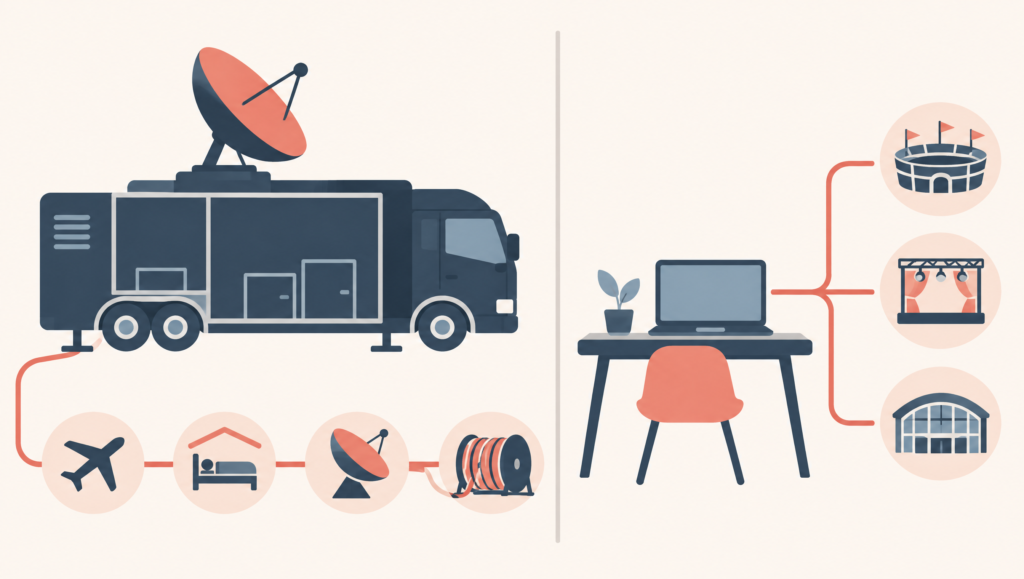
Traditional outside broadcast production puts the whole control room at the venue. An OB truck carries the switcher, replay, graphics and audio desks, and a satellite truck or leased fiber line sends the finished program back to the station. Every event pays for flights, hotels, transport and equipment wear for a full crew. A 2024 trends post from one encoder vendor says remote production can cut costs by up to 70 percent in some cases because a single crew can cover several events in a day.
The digital-first model separates capture from production. Only cameras, microphones and a small crew go to the venue, and encoders send each camera feed over IP to a central control room or a cloud production platform. Directors, replay operators and graphics staff work from that hub and can cover several venues in one day. Unlike the truck model, where each event carries the full cost of its production team, this model spreads that team across many events.
The label also describes where the content goes. Teams publish to streaming apps, social platforms and on-demand libraries at the same time, not to one linear program. According to a vendor case study, the sports streaming service SKWEEK streams EuroLeague basketball games with live local commentary to YouTube and social media and publishes them to its subscription video-on-demand service. The case study adds that commentators connect remotely as guests, and it credits that setup with more flexibility and lower preparation time and cost.
Where the savings come from
Crew travel is the largest and most predictable saving. Participants in a 2025 NewscastStudio industry roundtable said remote production can cut on-site crew requirements by 50 percent or more. Each person who works from the hub instead of the venue removes a flight, a hotel room and several days of per diem from the event budget.
Equipment and transmission costs fall next. A traditional production sends a truck loaded with switching, replay and audio equipment to every venue, along with the satellite or fiber capacity to carry the program back. All of it has to be shipped, powered and maintained for each event. A remote workflow sends far less hardware on site, since cameras and encoders stay at the venue while switching, graphics and replay run from software at a hub or from a crew spread across locations. That removes the mobile production unit at each location and the cost of renting satellite time or fiber for each event, and one hub can serve a different venue each day.
Fewer manual steps between camera and audience also reduce cost. One encoder vendor lists three steps that slow most newsrooms: retrieving footage, routing outside feeds into the production, and publishing clips. Each takes staff time and adds delay. When feeds are recorded automatically, IP and social sources come in through a cloud gateway, and a production platform publishes to several destinations at once, a smaller team covers more output. The same vendor describes a regional news team that chose one integrated workflow for broadcast and digital instead of two parallel systems, and that choice avoided the cost and complexity of running both.
For more on cloud tools that take over truck work, see The Complete Guide to Cloud Production Tools for Live Broadcasting Without a Production Truck.
What the published savings figures measure
The size of the savings depends on how it is measured. A review by EAR found broadcaster-reported savings of 10 to 30 percent per event, against 40 to 70 percent in vendor estimates. The largest gains appeared when one control room produced several events a day. A vendor’s sports production page cites savings of up to 70 percent for its cloud-based lightweight sports production solution.
The gap between the two ranges reflects the difference between one event measured alone and a full season run through the same hub. A single event lands near the broadcaster-reported range. A season of events through one hub lands closer to the vendor range.
Hybrid or fully remote: choosing a model
Most broadcasters do not have to choose one model for every production. Many run hybrid shows that keep part of the team on site while the main production runs from a hub. Podcasts, regional sports, press events and digital-only shows move to a fully remote setup.
The remote integration model, known as REMI, keeps cameras and a small crew at the venue while the rest of the team works from a central hub or from different locations. Fewer people and less equipment travel to each event, so one team can cover more events and more platforms with the same resources. A practical first move is the recurring event that currently sends the most people and equipment, since the per-event saving there is easiest to measure.
Do you know How Small Broadcast Teams Stream to Multiple Platforms at Once Without Extra Staff? Watch how a lean crew publishes one show to several destinations.
Costs a digital-first model keeps
Digital-first production moves some costs and leaves others in place. A central control room or cloud platform needs upfront investment, trained staff and subscriptions. Those costs pay back when the hub runs enough events, so a broadcaster producing several shows a week saves more than one with a handful of live shows a year.
Connectivity is the other fixed requirement. Every camera feed has to leave the venue reliably, often from stadiums or rural sites where networks are crowded or thin. A resilient plan layers bonded cellular, venue fiber or Ethernet, and satellite as parts of one setup, so no single connection carries the show. Contribution matters more in this model than in the truck model, because the people who would fix a problem are no longer on site.
The League of Live Stream Theater gives a documented case. According to the vendor’s press release, the nonprofit streamed Rent: The 30th Anniversary Concert from Broadway’s Richard Rodgers Theatre. The one-night benefit reached 70,000 streaming ticket buyers while in-person tickets sold out, and the 4.5-hour broadcast ran with no dropped streams. The crew had venue access only the evening before and on the day of the show, in an area with heavy cellular congestion, and a cloud production ran as a standby in case the main control room failed. The Gates Foundation pledged to match funds from streaming ticket sales up to $525,600.
LiveU’s encoders, LiveU Studio and LiveU Nexus, by the numbers
The table lists four LiveU products that map onto the cost lines covered above, with the figures LiveU and others have published for each.
| Product | What it does | Key figure (with source) | Best fit |
|---|---|---|---|
| LU800 field unit | Native 5G bonded encoder for venue contribution | LiveU lists up to 4 synchronized camera feeds | Multi-camera coverage without an SNG truck |
| LU810 fixed encoder | Permanent install at a recurring venue | A LiveU case study describes 8 Queensland race tracks producing from a Brisbane hub; The Broadcast Bridge reported savings of almost 80% at the most remote tracks | Venues used every week |
| LiveU Studio | Browser-based cloud production with switching, audio, graphics and replay | LiveU lists up to 8 remote guests and up to 30 destinations | Small teams producing multi-platform shows |
| LiveU Nexus | Cloud-native universal gateway for outside sources | LiveU lists SRT feeds, Zoom calls, YouTube streams and social lives as supported inputs | Productions that bring remote contributors and online sources into a live show |
The encoders address contribution from the venue, and the two cloud products address production and the intake of outside sources. A venue visited every week fits the fixed encoder, and an event that moves between locations fits a field unit.
The verdict for a recurring show: where to begin
The evidence points to a staged move. Pick the recurring event with the heaviest travel and truck cost, price its current per-event spending, and compare that with hub costs over the same number of events. Keep a hybrid setup for the largest productions, and move the smaller recurring shows to a fully remote setup once the hub has volume.
FAQ
Q: What is a digital-first broadcast workflow?
A: A digital-first broadcast workflow is a way of producing live video in which the main outputs are streams for platforms such as YouTube, social channels and broadcaster apps. The production runs over IP connections and cloud software. How video reaches production, by IP, cloud, truck or satellite, is a separate choice.
Q: What is REMI in broadcast production?
A: REMI stands for remote integration model. Cameras and a small crew stay at the venue, and the rest of the team works from a central hub or from different locations. Fewer people and less equipment travel to each event.
Q: Does a central hub pay off for a handful of events a year?
A: Less than it does for frequent events. The hub needs upfront investment, trained staff and subscriptions, and those costs pay back with volume. A broadcaster producing several shows a week saves more than one with a handful of live shows a year.
Q: Which destinations can LiveU Studio publish to?
A: LiveU Studio can publish to up to 30 destinations at the same time, depending on the package. Destinations can include CDNs, OTT platforms, social media and LiveU receivers for linear output.
Q: What does LiveU Ingest do?
A: LiveU Ingest records live feeds automatically and tags them with metadata. LiveU says this speeds up clipping and reuse across platforms.
Q: What do LiveU Video Return and IP Pipe add to a remote workflow?
A: LiveU Video Return and IP Pipe send return feeds to the venue and allow remote control of cameras and CCUs from the hub. LiveU says hub staff can then run venue equipment without traveling.