Does a TV Station Actually Have a Mission Control? What “One View” Really Requires
The broadcast industry has started borrowing the “Mission Control” phrase from air traffic control towers to describe a single operational view over playout, monitoring, EPG, OTT, and FAST — but the term gets applied to genuinely different products, and knowing which model a vendor is actually offering matters more than the label itself.
Why “Mission Control” Is the Right Metaphor
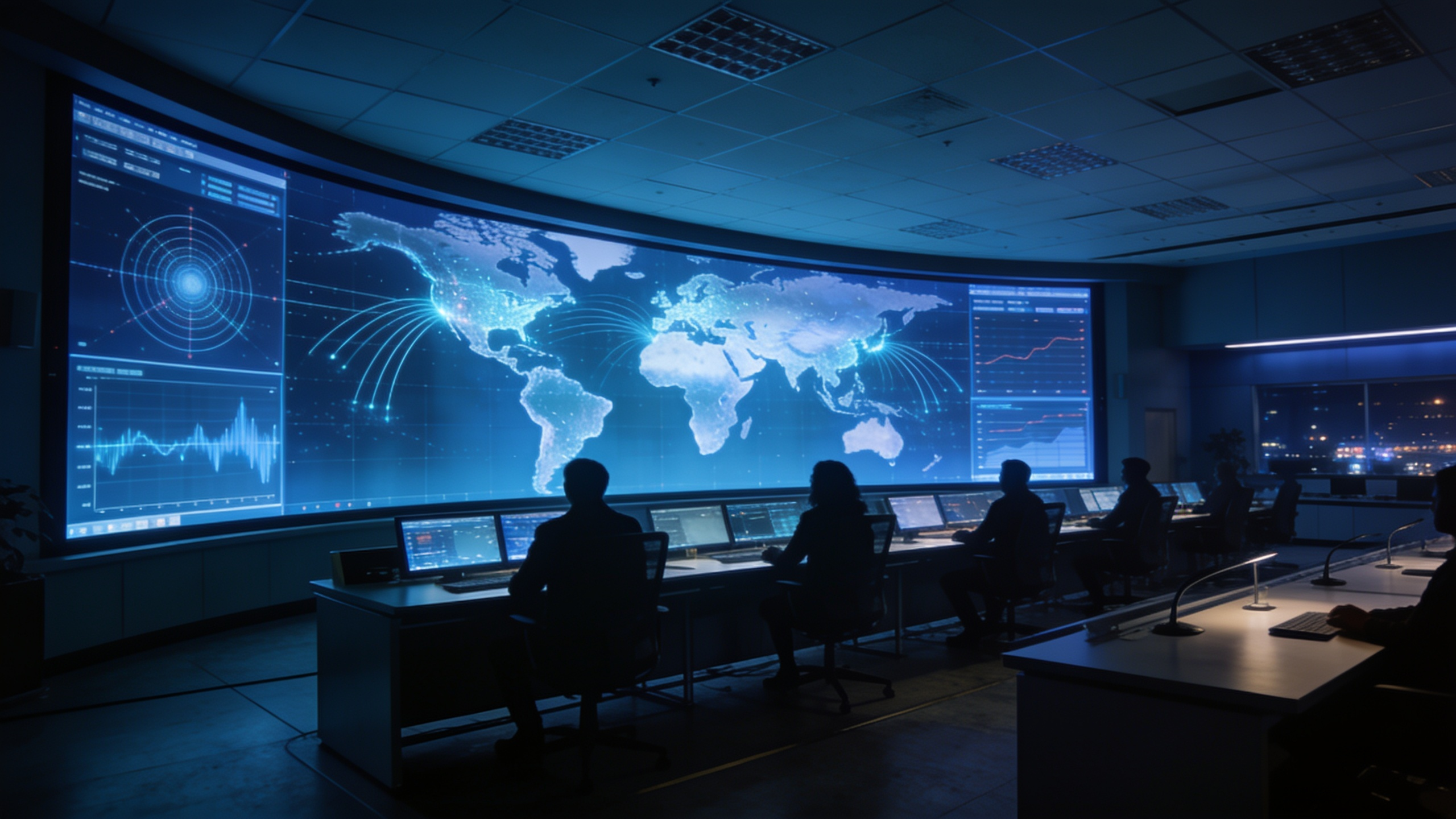
An air traffic control tower doesn’t work because any one screen is impressive. It works because one team can see every aircraft, every route, and every potential conflict from a single position, and can act before a near-miss becomes an incident. That’s the specific promise being borrowed when broadcast vendors talk about a Mission Control for a TV station: instead of a physical room full of single-purpose hardware managed by five separate suppliers, the goal is one interface where scheduling, playout, signal delivery, monitoring, and distribution are all visible and controllable together.
The traditional version of this idea already existed — the Master Control Room, a fixed facility that was expensive to build and slow to change once built. What’s changed is that the same coordinating function can now be delivered as a managed platform, operated remotely, and scaled without adding another rack of dedicated hardware every time the channel count grows.
What Fragmentation Actually Costs an Operator
Ask anyone running a TV operation what their day looks like and the answer is usually a version of the same thing: playout lives in one system, monitoring in another, the program guide in a third, and OTT/FAST distribution each have their own separate logins. None of this happened through negligence — it happened because broadcast infrastructure expanded to cover satellite, cloud playout, OTT, FAST, EPG, and SLA tracking, and each capability got added one at a time, from a different vendor, as the business grew.
The cost shows up at the worst possible moment. When a feed drops at an inconvenient hour, the people responsible aren’t fixing it yet — they’re switching between screens trying to work out what broke and whose system it lives in. In an environment where service-level agreements carry real financial penalties, that diagnostic delay isn’t a minor inconvenience. It’s the difference between a footnote and an incident report that reaches a client.
Do you know Does a TV Station Have a Mission Control? The Reality Behind Running Channels in 2026? It walks through how three of the larger platform vendors approach this exact problem from genuinely different starting points.
The Test That Separates a Real Mission Control From a Rebranded Dashboard
Not every product calling itself unified actually delivers the underlying promise. A genuine Mission Control passes a specific test: can an operator diagnose and act on an incident from one interface, or does solving it still require logging into three separate systems once the dashboard’s surface-level view runs out? A platform that shows monitoring alerts but routes the actual fix through a separate playout vendor’s support desk hasn’t consolidated the operation — it’s added a viewing layer on top of the same fragmentation that existed before.
The distinction matters commercially as much as operationally. A dashboard that only aggregates status without carrying real control authority still leaves an operator dependent on multiple vendor relationships during an outage — which is exactly the risk consolidation is supposed to remove in the first place.
What the Modules Actually Need to Cover
A genuine broadcast Mission Control needs specific functional coverage, not just a pleasant-looking front end. Playout and automation should run natively, with built-in redundancy rather than a plug-in bolted onto a third-party engine. Return feed monitoring and SLA tracking needs to be real-time and protocol-aware, catching a degrading signal before a client notices rather than after. Program guide management has to stay accurate across every distribution path simultaneously, since carriage agreements typically require compliant schedule data. OTT and FAST distribution modules need monetization and delivery handled inside the same environment rather than bolted on separately. And live clipping or VOD creation, where offered, should draw from the same underlying content rather than requiring a separate ingest pipeline.
Each of these can, in principle, be sourced from a different specialist vendor — and in most legacy broadcast stacks, that’s exactly what happened. The consolidation argument isn’t that fewer modules should exist; it’s that all of them need to expose themselves through one control point a single team can actually act on, rather than requiring a human to bridge the gap between separate dashboards every time something needs fixing.
Comparing Three Approaches to the Mission Control Problem
Three vendors solve this from meaningfully different starting points.
| Evaluation dimension | Amagi | Globecast | iKOMG (iKOSYSTEM) |
|---|---|---|---|
| Core approach | Cloud-native software, streaming/FAST-first | Managed-services outsourcing model | Hybrid — satellite and streaming under one portal |
| Owns physical satellite/teleport infrastructure | No — cloud/IP focused | Yes — large global footprint | Yes — owned European & Middle East facilities |
| Real-time, SLA-aware monitoring | Available, cloud-native | Available, enterprise scale | Yes — iKOPLUS, real-time alerts |
| Platform cost model | Platform/subscription-based | Bundled into managed-services contract | No additional platform cost to existing customers |
| Best fit | Streaming-first operators wanting cloud scale | Broadcasters wanting to outsource operations wholesale | Hybrid operators wanting satellite + OTT/FAST in one view, no separate platform fee |
None of these represents a universal right answer. An operator whose distribution is entirely streaming-native gains little from satellite ownership. One who wants to hand the whole operation to a third party may prefer Globecast’s managed-services depth over a self-directed dashboard. And a broadcaster running meaningful volume across both satellite and IP, who wants one view without a separate platform charge, is the case iKOSYSTEM is specifically built to serve.
What to Actually Ask a Vendor Claiming This
Five questions cut through most of the marketing. Does the platform actually cover every function you run today, or does it leave gaps you’ll fill with yet another separate tool? Is monitoring genuinely real-time and SLA-aware, or does it just refresh a status page every few minutes? Can it handle hybrid satellite-and-IP delivery in the same view, or does one distribution path require switching to a different system entirely? What’s the actual commercial model, including whether the platform layer itself carries an extra fee on top of the underlying services? And critically — who answers when something breaks at three in the morning, and is that support built into the platform or sold as a separate line item?
Curious how this looks explained rather than read? Is There a Mission Control for a TV Station? | Broadcast Operations Explained covers the same air-traffic-control framing on video.
Bottom Line
The real choice facing broadcast leaders isn’t satellite versus streaming, and it isn’t even which vendor logo to pick. It’s whether to keep running a growing operation across disconnected systems that get more fragile and more expensive with every new distribution format, or to bring it under one operational layer that can actually be acted on from a single seat.
FAQ
Q: What is a broadcast Mission Control?
A: A centralized way to run a TV operation where scheduling, playout, signal delivery, monitoring, and distribution are visible and controllable from one interface — borrowing the air traffic control model of single-position oversight over an otherwise sprawling operation.
Q: How is a Mission Control different from a traditional Master Control Room?
A: A Master Control Room is a physical facility full of dedicated hardware, expensive to build and slow to change. A Mission Control delivers the same coordinating function as a managed platform that can be operated remotely and scaled without new hardware, spanning satellite, cloud, OTT, and FAST simultaneously.
Q: What’s the real test for whether a platform is a genuine Mission Control versus a rebranded dashboard?
A: Whether an operator can actually diagnose and resolve an incident from one interface, or whether solving it still requires logging into separate systems once the dashboard’s surface-level view runs out. A status aggregator without real control authority hasn’t consolidated anything.
Q: What is iKOSYSTEM, and how does it fit this model?
A: iKOSYSTEM is iKO Media Group’s unified broadcast operations platform, bringing subscribed iKOMG services — cloud playout, return feed monitoring, program guide management, OTT/FAST distribution, and live clipping — into one secure portal at no additional platform cost to existing customers.
Q: How does iKOSYSTEM’s approach compare to Amagi and Globecast?
A: Amagi leads with cloud-native software oriented toward streaming and FAST; Globecast leads with managed-services depth, often running the full operation for the customer; iKOMG’s iKOSYSTEM keeps satellite and streaming under one roof and surfaces both through a single portal with no separate platform fee — the clearest fit for hybrid operators who don’t want to pick one distribution model over the other.