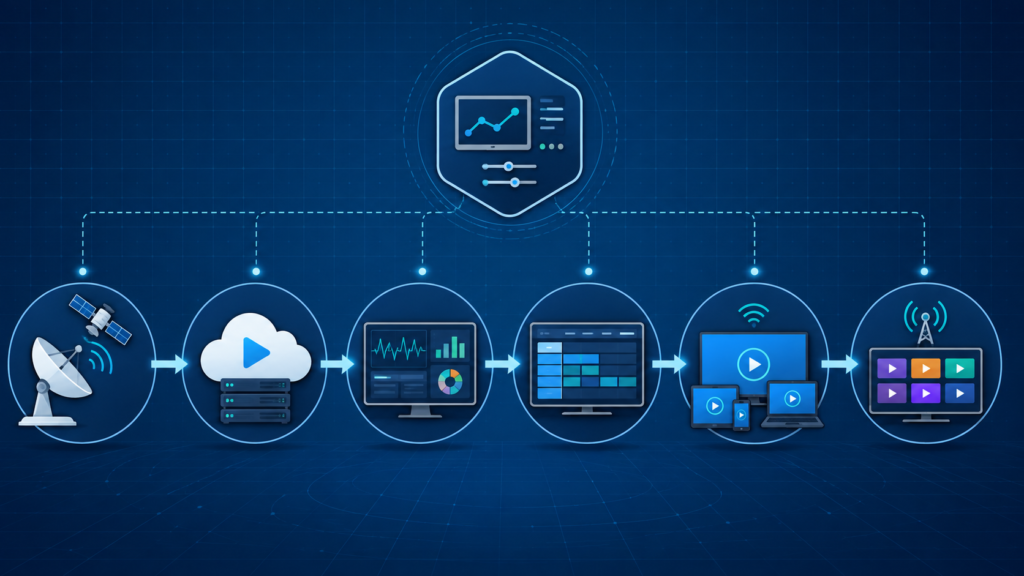
Broadcast vendor fragmentation happens because each new distribution requirement, satellite, cloud playout, OTT, FAST, EPG, has historically been solved by adopting a separate specialized system rather than extending one that already exists. The result, over enough years, is an operator holding five or six logins and no single view of the full signal path. Here’s the full breakdown: where fragmentation actually comes from, why it compounds instead of staying manageable, what it costs beyond the obvious, and what a consolidated platform changes.
Where Broadcast Fragmentation Actually Comes From
Fragmentation builds up one integration at a time, not through a single bad decision. A channel typically starts with satellite distribution and a playout system. It adds OTT for connected TVs and mobile apps, usually through a different vendor built specifically for streaming rather than broadcast. An EPG tool follows to meet carriage requirements with cable and DTH platforms. A monitoring system gets layered in for return-feed issues. Eventually, once ad-supported streaming becomes worth pursuing, a FAST setup joins the stack, frequently through a fourth or fifth vendor relationship.
Each addition solves a genuine, immediate problem. None of them was designed with the others in mind, because each one was typically purchased under a separate budget cycle, often years apart, from vendors with no reason to coordinate.
The Functional Layers That End Up Split Across Vendors
Understanding fragmentation requires understanding what actually gets split apart. Broadcast operations span a consistent set of functional layers, and in a fragmented setup, each one is commonly owned by a different provider.
| Layer | What It Does | Typical Fragmentation Pattern |
|---|---|---|
| Ingest and contribution | Brings content into the broadcast chain via satellite, fiber, or IP | Often tied to whichever vendor supplied the original playout system |
| Playout and scheduling | Manages what goes to air, when, and with what automation | Frequently the oldest system in the stack, least connected to newer additions |
| Monitoring | Tracks signal health and SLA compliance across delivery paths | Commonly split by delivery type — satellite monitoring separate from IP monitoring |
| EPG | Generates and distributes programme guide data for carriage requirements | Usually a standalone tool bought specifically to meet a carriage deadline |
| OTT distribution | Packages and delivers content to connected devices and apps | Typically a separate vendor from the original satellite/playout relationship |
| FAST automation | Manages ad-supported channel scheduling and ad insertion | Often the newest and most disconnected layer, added last |
Six layers, six potential vendors, and no default mechanism forcing any of them to share information with the others. That’s the structural root of the problem.
Why the Problem Compounds Instead of Staying Manageable
The mechanism that makes fragmentation worse over time is coordination cost, and it does not scale in a straight line with the number of vendors. Two disconnected systems create one integration point a team can track manually without much strain. Six systems mean checking six dashboards and training staff across six interfaces, frequently during a live incident when response speed matters most.
The incident process typically breaks into three steps. First, someone has to notice something is wrong, usually by comparing outputs across systems that were never built to communicate with one another. Second, they determine which vendor actually owns the problem. Third, they escalate to that vendor’s separate support process, while the remaining systems keep running, unaware anything has changed. None of these steps is especially difficult in isolation. Together, under time pressure, they are where broadcast operations tend to break down.
For more on how this shows up specifically in FAST channel growth, see Stop Managing Five Vendors to Run One TV Channel, which examines the structural inefficiency case in more detail.
What Fragmentation Costs Beyond the Obvious
The visible cost is staff time spent switching between systems instead of managing content or growing an audience. The less visible cost is risk: a monitoring gap between two disconnected platforms is exactly where an undetected outage tends to live, since no single system has visibility into the full signal path from ingest to delivery.
Fragmentation also slows decision-making. An operator evaluating a new FAST feed typically has to gather data manually from several separate systems before analysis can even begin, which turns what should be an hours-long decision into a days-long one. None of this means multi-vendor broadcasting is inherently unworkable. It means the coordination layer between vendors has, until fairly recently, been left for each broadcaster to build for itself, one integration at a time.
For more on what that coordination layer actually looks like once it’s consolidated, How to Build a Modern TV Channel Without Managing 5 Different Vendors walks through the practical shift from a patchwork setup to a single operational view.
About iKOMG
iKO Media Group, known as iKOMG, is one provider positioned specifically around this coordination problem. Its platform, iKOSYSTEM, consolidates a broadcaster’s subscribed services into a single secure login rather than functioning as another standalone tool added to an already fragmented stack. Depending on subscription, that can include iKOBMS for broadcast management, iKOCLOUD for cloud playout, iKOPLUS for return-feed monitoring, iKOGUIDE for EPG, iKOCLIPS for live clipping, iKOFAST for FAST automation, iKOOTT for OTT distribution, and iKOQ for engagement, accessible from one dashboard rather than several.
iKOMG states that services appear within iKOSYSTEM based on what a customer is actually subscribed to, so the platform is designed to grow alongside a contract instead of requiring a new integration project each time a broadcaster adds a service. The company frames iKOSYSTEM as a coordination layer over existing infrastructure rather than a replacement for the underlying satellite, cloud, or OTT services a broadcaster already depends on, which is a meaningfully different claim than simply offering another tool.
Bottom Line
Broadcast vendor fragmentation is not the result of any single bad procurement decision. It’s the accumulated byproduct of distribution requirements multiplying faster than back-office tooling has consolidated to match them. The practical way to evaluate your own exposure is to count logins: how many separate systems does a duty engineer check to confirm a channel is healthy from ingest through delivery. More than two or three, and coordination cost is likely outweighing the benefit each specialized tool provides individually. A consolidated platform doesn’t replace the underlying satellite, cloud, OTT, and FAST services doing the actual work. It replaces the manual coordination between them, which is the part of fragmentation that most directly causes downtime and slow decisions.
FAQs
Q: Why do broadcast operations become fragmented across multiple vendors?
A: Each new distribution requirement, such as satellite, cloud playout, OTT, FAST, or EPG, has historically been solved by adopting a separate specialized system rather than extending one already in use. No single vendor decision looks wrong in isolation; the fragmentation only becomes visible once an operator has to coordinate across all of them during an incident.
Q: What’s the biggest hidden cost of a fragmented broadcast stack?
A: The visible cost is staff time. The less visible and often larger cost is risk: a monitoring gap between two platforms that were never built to communicate is exactly where an undetected outage tends to live, since no single system sees the complete signal path.
Q: What is iKOSYSTEM?
A: iKOSYSTEM is iKO Media Group’s unified broadcast operations platform. It gives customers single sign-on access to their subscribed services across playout, monitoring, EPG, OTT, FAST, and engagement tools through one dashboard.
Q: Does iKOSYSTEM replace a broadcaster’s existing satellite, cloud, or OTT services?
A: No. iKOSYSTEM consolidates access to whichever iKOMG services a customer already subscribes to into one login and operational view; it does not replace the underlying infrastructure and services themselves.
Q: How many vendors does it typically take to run a modern TV channel?
A: There’s no fixed number, but broadcasters running satellite, OTT, and FAST simultaneously, each with separate monitoring and EPG tools, commonly land at five or six distinct vendor relationships once every layer is counted.
Q: What individual tools does iKOSYSTEM bring together?
A: iKOSYSTEM connects iKOBMS for broadcast management, iKOCLOUD for cloud playout, iKOPLUS for return-feed monitoring, iKOGUIDE for EPG, iKOCLIPS for live clipping, iKOFAST for FAST automation, iKOOTT for OTT distribution, and iKOQ for engagement, based on each customer’s subscriptions.