Short answer: a small broadcast team can reliably push one live signal to a cable feed, YouTube, and social clips simultaneously, but only if the underlying transport technology is built to react to network trouble on its own, because a lean crew rarely has a spare person watching the connection full time. This guide breaks down why multi-platform live production strains a small team specifically, what actually fails first, and who else builds in this general category.
Why multi-platform live production is a crew-size problem, not just a technology one
Pushing a single live shoot to several destinations at once sounds like a distribution question: point the same signal at a cable partner, a YouTube simulcast, and a couple of social clips, and let each audience choose their platform. In practice, it’s a reliability question, because every destination depends on the same underlying connection. A glitch on that connection doesn’t hit one platform. It hits all of them, at the same instant, in front of every audience simultaneously.
A large broadcast operation absorbs this risk with headcount: a dedicated engineer monitoring the transport layer, ready to react the moment a connection wavers. A three- or four-person field crew doesn’t have that person to spare. Whoever would normally watch the transmission chain is usually also running camera, audio, or the actual production switch. That gap, not ambition or budget, is the real ceiling on how many platforms a small team can safely serve at once.
What breaks first: the disconnect between the router and the encoder
For years, the standard fix for unreliable field connectivity was a general-purpose bonding router: a device that bundles several cellular SIM cards from different carriers into a single, sturdier internet connection. This category of hardware, think Peplink, Cradlepoint, or Speedify, is genuinely well engineered for its intended job. It’s how ambulances stay connected on the move, how remote offices function without fiber, and how news vans get online while driving.
The limitation is that these routers have no visibility into what’s actually flowing through the connection they’re managing. A live video stream looks the same to a general bonding router as an email attachment or a background software update: just data to move. The video encoder, the device actually building the picture being broadcast, sits on top of that router as a completely separate piece of equipment. The two don’t communicate.
That separation is where the failure shows up. When one bonded connection drops, say a crew drives through a dead zone or a venue’s local cell tower gets saturated by a packed crowd, the router quietly starts rerouting traffic behind the scenes. The encoder has no idea any of this happened. It keeps pushing the same bitrate it was pushing a moment earlier, because nothing has told it conditions changed. By the time the encoder detects a problem on its own, frames have already dropped and artifacts have already appeared on every destination the stream is feeding.
Do you know how a live broadcast can absorb a Zoom call, a livestream, and a social clip without adding a single piece of extra hardware to the chain? The underlying shift is the same one covered here: work that used to require a dedicated technical specialist now runs automatically inside systems built to handle it.
What integrated video bonding does differently
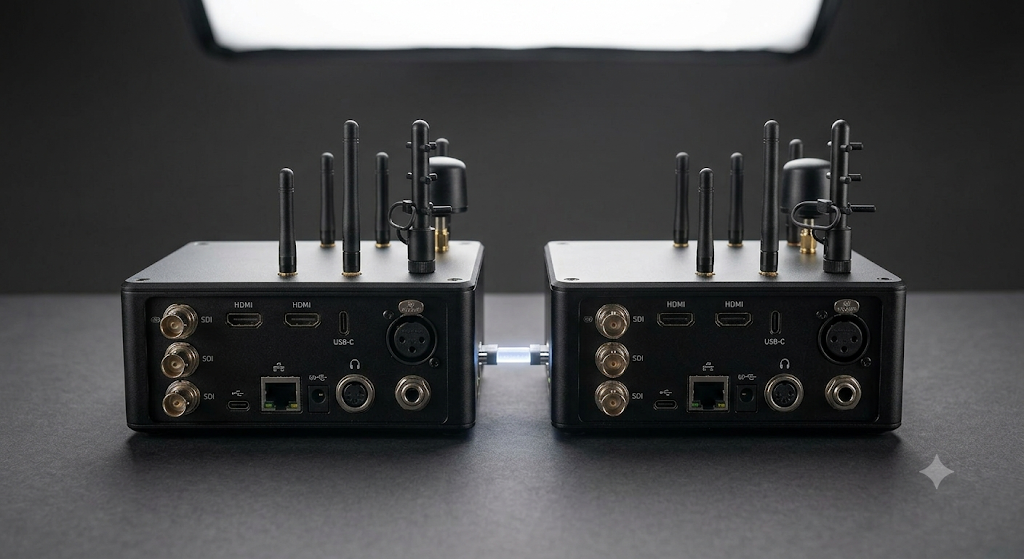
The alternative to a general bonding router isn’t a bigger bonded pipe. It’s an architecture where the video encoder and the transport layer are the same system rather than two separate boxes that don’t talk. LiveU’s implementation of this is a protocol it calls LRT, LiveU Reliable Transport, and the defining trait is that it stays continuously aware of what the video itself needs, not just what the raw connection is doing.
Four things happen simultaneously, at all times, inside that kind of system: packets arriving out of sequence across multiple bonded connections get renumbered and reassembled correctly; a layer of redundant data self-heals lost packets automatically, scaled to current network conditions; a lightweight acknowledge-and-resend process catches genuinely missing data without adding noticeable delay; and, most importantly for a live audience, the moment available bandwidth drops, the transport layer tells the encoder immediately, so the encoder lowers its bitrate before frames are lost rather than reacting after a glitch has already aired. When conditions recover, the same signal pushes quality back up.
For a listen at how that kind of real-time signaling plays out from a production seat, From Link to Live Broadcast Feed covers a closely related shift in how outside sources make it to air.
How LiveU’s LRT Actually Works
The short answer: LiveU keeps the video encoder and the transport layer as one system rather than two separate devices, running on a protocol called LRT, LiveU Reliable Transport, which the company designed and patented for live video specifically.
LRT operates continuously, not only when a connection degrades:
| LRT Function | What It Does | Why It Matters |
| Packet ordering | Reorders packets arriving out of sequence across bonded connections | Prevents glitches from packets landing in the wrong order |
| Dynamic error correction | Adds redundant data scaled to network conditions | Recovers lost packets before the viewer notices |
| Acknowledge and resend | Flags missing packets and requests them again quickly | Closes gaps without adding noticeable delay |
| Adaptive bitrate | Signals the encoder to lower bitrate the moment bandwidth drops | Frames get protected before they’re lost, not after |
The practical effect is that quality adjustments happen early and gradually rather than as a visible stumble on screen. LiveU says more than 5,000 organizations, across news, sports, public safety, and independent production, currently run on this system. That scale is one data point; the more relevant one is that the correction runs on a continuous, automated basis, which a manually monitored connection can’t replicate.
Bottom line
A small crew’s real constraint in multi-platform live production isn’t ambition or even budget. It’s how much specialized technical attention a stream needs to survive a rough network, and how few people a lean team has to spare for that job. General-purpose bonding routers solve connectivity but not video reliability, because the encoder and the router were never designed to talk to each other. Integrated video bonding, where the encoding and transport run as one system, is what actually closes that gap for a team that can’t afford to dedicate a person to watching the connection during a live show.
FAQs
Q: Why is multi-platform live production riskier for a small crew than a single-destination broadcast?
A: Every additional destination depends on the same underlying connection, so a glitch affects all platforms simultaneously rather than just one. Small crews usually lack a dedicated person watching the transport layer in real time, which is what larger operations rely on to catch and compensate for connection trouble before it reaches air.
Q: What is the practical difference between general-purpose network bonding and broadcast-grade video bonding?
A: General bonding routers combine multiple cellular connections into a larger, sturdier pipe but have no awareness of what’s flowing through it, treating a live stream the same as any other data. Broadcast-grade video bonding, like LiveU’s LRT, keeps the encoder and transport in constant communication, adjusting bitrate before frames are lost instead of reacting after a glitch has already aired.
Q: Is LRT a shared industry standard, or is it proprietary to LiveU?
A: LRT is proprietary. LiveU designed and patented the protocol specifically for live video transport; it is not a shared or open standard used across the industry.
Q: Does integrated video bonding eliminate the need for a good baseline internet connection?
A: No. It changes how a stream behaves when the connection degrades, recovering from drops and adjusting bitrate before viewers notice, but it cannot generate bandwidth that isn’t available. A reasonable baseline connection is still required; the technology determines what happens when that connection gets rough.