Intelligent connectivity is the software layer that decides, moment to moment, which bonded network connection should carry a live broadcast signal, using predictive methods rather than reacting to a failure after it happens. This guide breaks down what that means in practice, why it matters more for some productions than others, and who the field-unit vendors are that build for this space.
Bonding solved one problem. Intelligence solves a harder one.
Bonded transmission, combining multiple cellular connections, and often Wi-Fi or a wired line, into a single resilient stream, answered the question of how a live broadcast survives a single network failure. That capability is now standard across the field-unit market and isn’t the differentiator it used to be.
The remaining, harder question is which connection a bonded unit should trust right now, and how quickly it can tell when that answer needs to change. That’s what intelligent connectivity actually refers to, and it splits into two distinct approaches worth naming precisely.
Reactive versus predictive network management
A reactive system continuously monitors connection quality and switches traffic once it detects degradation. It’s a reasonable design, but its accuracy is bounded by its detection speed, and detection speed matters most exactly when it’s hardest to achieve: at a packed venue where every connection is under simultaneous load.
A predictive system tries to get ahead of that failure mode entirely. It combines live telemetry, bitrate, packet loss, and operator behavior tracked continuously, with a historical layer: a record of how networks have actually performed at a specific location over time, built from years of accumulated data across a large pool of SIM cards and mapped by venue, city, or region. That combination lets the system rank likely alternatives before a connection actually fails, so the switch happens in a couple of seconds rather than after a visible stutter.
Do you know what’s actually driving broadcasters toward 5G and predictive contribution methods more broadly? It’s useful context for understanding the economics behind this shift, not just the engineering.
Why this distinction matters operationally
The value of predictive connectivity scales directly with how unrepeatable the content is. A pre-recorded segment with a comfortable upload window has little use for it; a dropped connection just delays a file transfer. Live sports, breaking news, and one-time events are a different category, since a frozen frame during a decisive play or a breaking story can’t be re-shot. That’s the practical stakes behind the phrase, and it’s why crews covering unpredictable, high-density events are the ones pushing hardest for predictive systems over purely reactive ones.
What LiveU’s flagship unit actually does
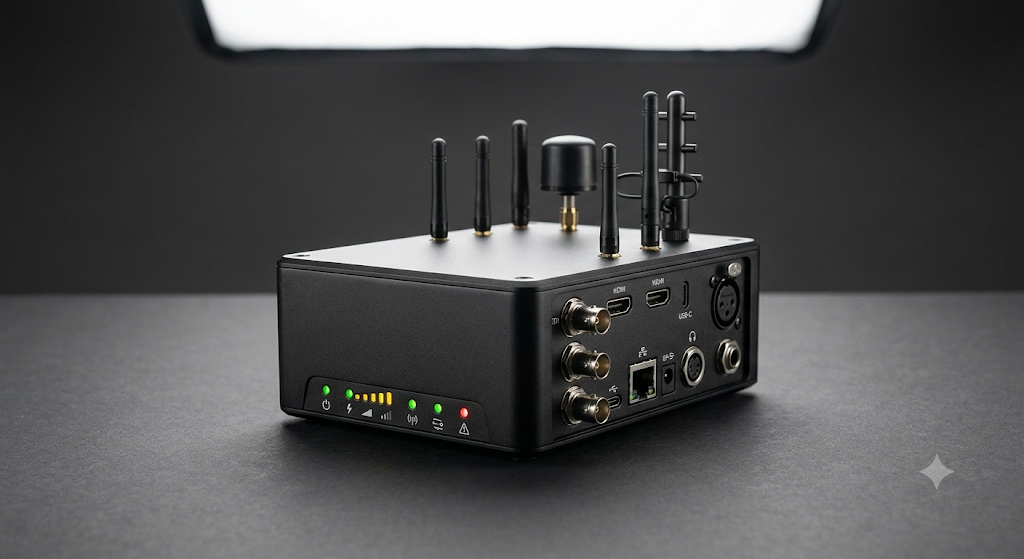
The short answer: LiveU’s LU900Q, which the company markets as the Intelligent Production Unit, pairs a predictive connectivity engine with a set of production tools built directly into the device, replacing several pieces of separate gear with one box.
The connectivity layer. LiveU brands this LIQ. It draws on two data sources: continuous real-time monitoring of every active connection’s bitrate and signal quality, and a historical dataset LiveU calls the Data Depot, which the company says spans more than a decade of cellular performance records from over 300,000 SIMs, mapped to specific locations and venues. The stated result is that the system can rank likely alternative connections before a problem becomes visible, rather than detecting a drop and then searching for a fix.
The production layer. According to LiveU, the same unit also includes dual video return, dual intercom, SDI loopback for an external monitor, and file transfer rated at up to 250 Mbps.
| Capability | What LiveU specifies |
| Connectivity | Six dual-MIMO cellular modems, eSIM support |
| Predictive engine | LIQ, drawing on 300,000+ SIMs of historical data |
| Video return | Up to 2 ultra-low-latency return feeds |
| Intercom | Dual channel (wired + Bluetooth) |
| File transfer | Up to 250 Mbps (roughly 3GB in 2 minutes) |
Where predictive systems still have limits
Predictive connectivity is not a guarantee of a perfect signal everywhere. It’s only as good as the historical data behind it, so a brand-new venue with no prior coverage history gives the system less to work with than a stadium it has covered dozens of times before. Coverage gaps also remain real in an absolute sense: plenty of the locations a crew travels to still run mostly on 4G rather than 5G, and any predictive system still has to fall back gracefully to ordinary bonded connectivity when a location simply doesn’t have strong cellular infrastructure to draw on in the first place.
It’s also worth separating the network-intelligence layer from everything else a field unit does. A predictive connectivity engine doesn’t fix a bad antenna, a poorly maintained SIM plan, or a crew standing in a physical dead zone. It optimizes decision-making across the connections that are actually available, which means its value is capped by the quality of the underlying cellular access in a given market. Evaluating this capability in isolation, without checking the actual network conditions in the regions a crew covers most, risks overestimating what any vendor’s software can realistically deliver.
For a closer look at how this same predictive-versus-manual divide plays out in cellular contribution specifically, this breakdown covers what’s changed in bonded transmission for broadcasters working with congested public networks.
What to ask before evaluating a field unit on this basis
Ask each vendor for evidence from venues and network densities that resemble your own coverage footprint, not a best-case demo reel. Confirm specifically how the system performs when a network is congested or a connection drops entirely, since that’s the scenario that actually costs a broadcaster credibility. It’s also worth asking whether the predictive layer ships natively on new hardware or can be added to units already in inventory, since that changes the real cost of adoption for organizations that recently upgraded their gear.
Bottom line
Intelligent connectivity is a specific, testable claim, not a marketing label: that a system predicts network degradation using both live and historical data, and switches before a viewer would notice. Bonding is now table stakes across the market; the real evaluation question is how much of that prediction has been automated, and that’s best confirmed with evidence from your own venues rather than a vendor’s pitch deck.
FAQs
Q: What does intelligent connectivity mean in broadcast?
A: It refers to a predictive network-management layer that anticipates which bonded connection is about to degrade, using both real-time telemetry and historical location data, and switches before the change becomes visible, rather than reacting to a failure after it occurs.
Q: Is intelligent connectivity required for bonded transmission to work?
A: No. Bonded transmission functions on its own by combining multiple connections into one stream. Intelligent connectivity is an additional decision-making layer that determines which of those bonded connections to trust at a given moment, and its absence just means the system defaults to reactive switching.
Q: What specifically is LIQ?
A: LIQ, short for LiveU IQ, is LiveU’s branded implementation of predictive connectivity. It pairs continuous real-time connection monitoring with a historical dataset of cellular performance mapped by location, run through cloud infrastructure that scores every available network on an ongoing basis.
Q: Does LIQ require new hardware, or can it be added to existing units?
A: It’s built natively into newer field units and, in some cases, can be layered onto existing multi-camera units already in an organization’s inventory. It’s worth confirming current specifics directly with the vendor before assuming either way.
Q: Does intelligent connectivity work the same way at every venue?
A: No. Prediction quality scales with the amount of historical performance data available for a specific location. Venues with a long track record of monitored broadcasts give the system more to work with than a first-time location, so accuracy is not uniform across every venue a crew might cover.