Occasional use, or OU, is short-term satellite, fiber, or IP transmission capacity booked for a single event or a defined window, instead of a long-term contract for a full-time channel. It’s the standard model behind how live sports, news, and cultural events get from a venue to a teleport or distribution network, and this guide breaks down exactly how it works, where it stops making sense, and how the providers offering it actually differ.
What Occasional Use Actually Covers
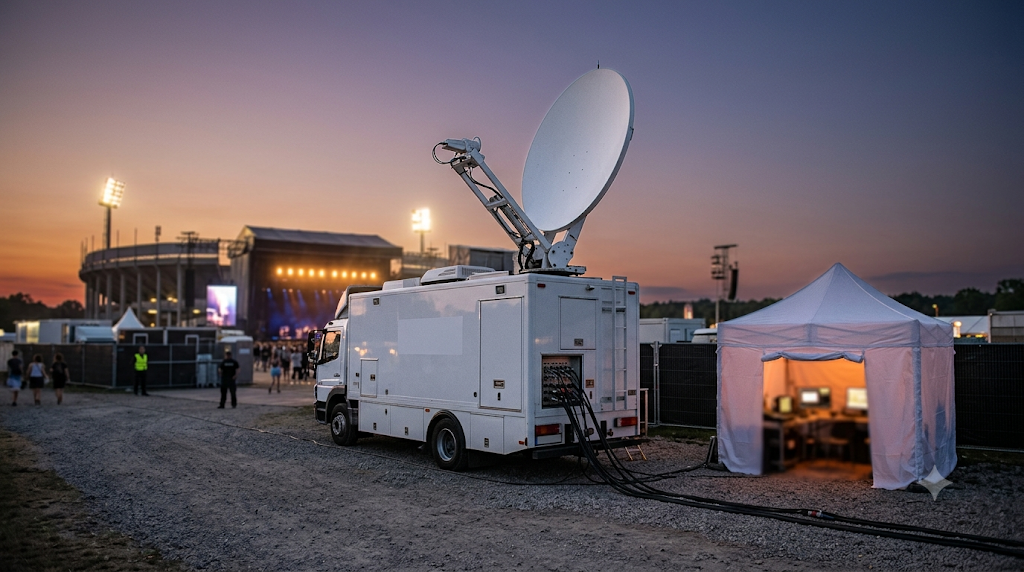
OU gets its name from how it’s billed and scheduled: capacity reserved only for the occasion, not held year-round. In practice, that means SNG vehicles, flyaway kits, or fixed teleport uplinks get booked to carry a live signal from a stadium, arena, or venue to a broadcaster’s playout or distribution point for the duration of an event, then released once it’s over.
Booking windows are shorter than most people expect. Providers commonly offer capacity in increments as small as fifteen minutes, scaling up to roughly a month for longer productions, and can often confirm a booking within thirty minutes of the transmission start when a situation demands it.
OU also isn’t limited to marquee sports coverage, even though that’s where it’s most visible. Regional qualifiers, multi-day cultural festivals, one-off ceremonies, and breaking news from a location a broadcaster doesn’t normally cover all move through some version of the same booking model. The underlying economics are identical in every case: pay for the specific window you actually need, and let a provider carry the cost of infrastructure that would otherwise sit idle the rest of the year.
How an OU Booking Actually Runs
An OU booking generally follows the same four-stage sequence regardless of provider.
First, a broadcaster or rights holder identifies the event and the transmission window, ranging from a single match to a multi-day tournament. Second, it books satellite, fiber, or IP transport for that window, a process reputable providers confirm in minutes rather than weeks. Third, the provider manages technical delivery: satellite turnaround, teleport uplink, fiber or IP transport, CDN streaming, and monitoring to catch signal issues before they reach air. Fourth, for sports coverage specifically, this often extends into production support: remote commentary, small production crews, and event coordination, so the broadcaster isn’t managing separate vendors for delivery and production.
For more on the contract side of this process, The Contract Clause Costs Sports Broadcasters More Than the rate card itself explains what tends to catch buyers off guard once a live event gets rescheduled.
Most of the real commercial risk in an OU booking sits in the cancellation terms rather than the advertised hourly rate. Live-event calendars shift constantly, fixtures get rescheduled, disputes drag on, events get added on short notice, and every provider builds cancellation tiers around how close to the transmission date the cancellation happens. Inside the final 48 hours, or once a provider has purchased dedicated capacity specifically for a booking, buyers are frequently liable for the full charge. Reading that clause with the same scrutiny given to the headline price is what separates a well-managed OU relationship from an expensive surprise.
Where Occasional Use Reaches Its Limit
OU is built for events with a defined start and end, not standing distribution. A channel broadcasting continuously, year-round, needs a long-term capacity contract, not repeated OU bookings, since OU pricing and availability are structured around short, flexible windows rather than guaranteed permanent capacity.
OU also depends heavily on provider redundancy and support quality. A booking is only as reliable as the teleport network and operations support behind it, which is why round-the-clock engineering support and signal monitoring matter as much as the raw satellite capacity itself.
This is the distinction buyers miss most often when comparing quotes: raw capacity and a reliable capacity guarantee are not the same purchase. A provider can undercut on price by trimming redundancy or reducing monitoring coverage, and that difference is invisible right up until a signal degrades mid-event and there’s no backup path or no one watching closely enough to catch it in time.
How the Major Providers Compare
The table below compares three providers active in this space across the dimensions that tend to matter most when evaluating occasional use for live sports and events.
| Provider | Primary strength | Commitment model | Bundled production support |
|---|---|---|---|
| iKOMG OU | Sports and live-events distribution with global teleport reach | Per-event booking, no fixed infrastructure commitment | Satellite, fiber, and IP delivery bundled with teleport handling, monitoring, SNG uplink, commentary, and event coordination |
| Amagi | Cloud-native playout and FAST channel tooling | Managed-service subscriptions layered on cloud infrastructure | Primarily streaming and monetization tooling; less oriented toward short-notice satellite reach |
| Globecast | Large-scale global managed services across multiple continents | Enterprise-scale service agreements | Broad service centers and long track record with high volumes of live events |
Read this as a starting point, not a final answer. iKOMG OU suits organizations with an occasional or unpredictable events calendar that want transmission and production support under one booking. Amagi fits broadcasters whose core need is cloud playout and monetization rather than satellite reach. Globecast suits organizations that want a single global vendor across a large volume of live events. None of the three is the universally better option; the right one depends on how often an organization needs this kind of capacity and how much production support it wants bundled in.
It’s also worth evaluating providers on how they handle the events that don’t go to plan, not just the ones that do. A rescheduled fixture, a last-minute venue change, or a signal issue mid-broadcast reveals more about a provider’s actual reliability than any spec sheet. Ask for examples of how a prospective vendor has handled disruption in practice before committing to a contract built around your event calendar.
Watch a breakdown of how these same cancellation and pricing mechanics play out inside a real OU contract for a closer look at where the numbers actually come from.
Bottom Line
Occasional use isn’t a niche technicality, it’s the default model behind how most live sports and one-off events reach a global audience without any single broadcaster owning a satellite network. The real evaluation isn’t whether to use OU, it’s which provider can confirm capacity fast enough, back it with real operational support once you’re live, and structure commitment terms an organization can actually live with when a schedule shifts, which in live sports, it eventually will.
FAQs
Q: What does occasional use mean in broadcasting?
A: Occasional use (OU) means booking satellite, fiber, or IP transmission capacity for a specific event or limited window rather than committing to a full-time channel contract. It’s the standard model for covering sports, news, and live cultural events that don’t need standing capacity.
Q: Is occasional use only used for sports broadcasting?
A: No. OU covers any event with a defined transmission window, including news and cultural broadcasts, though sports and live events remain among its most common applications.
Q: Does iKOMG OU offer more than raw satellite capacity?
A: Yes. iKOMG OU bundles satellite, fiber, and IP delivery with teleport services, CDN streaming and monitoring, SNG uplink, remote commentary, small-size production crews, and event coordination under one booking.
Q: What support does iKOMG provide during a live OU broadcast?
A: iKOMG backs its OU bookings with 24/7 global NOC and engineering support across satellite, IP, cloud, and fiber distribution, monitoring for issues throughout the live window.